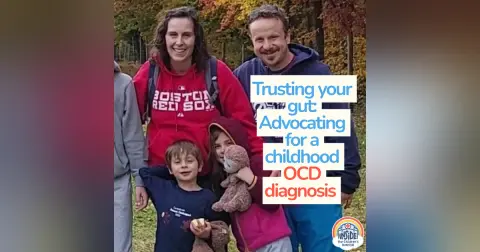
Trusting your gut: Advocating for a childhood OCD Diagnosis


Key Takeaways
- Kristy Berksza shares her personal and professional experience as both a child life specialist and a parent navigating a childhood OCD diagnosis for her daughter, Maggie.
- Parental intuition plays a crucial role in advocating for a child's mental health, especially when symptoms like school refusal and anxiety are masked outside the home.
- Transparency and open communication about mental health diagnoses help children understand their neurodivergence and feel more comfortable with treatments like therapy and medication.
- Combining medication and therapeutic support can create a positive and impactful difference in a child's quality of life and ability to manage symptoms.
- Finding community and acknowledging the emotional challenges of caregiving are essential for parents navigating pediatric healthcare and mental health journeys.
In this week's episode, Kristy Berksza, a mom and former Child Life Specialist, tells us how her experience being a healthcare professional and a parent taught her how to communicate a diagnosis to her own daughter. Maggie, Kristy's daughter, was diagnosed with OCD last year when her refusal to go to school worsened.
Being a former CLS, Kristy has been able to better support Maggie and explain what the diagnosis means for her going forward. Kristy tells us how a mixture of both medication and therapy that she advocated for have helped create a positive difference in Maggie's quality of life!
Timestamps
1:33 - Introduction to Kristy
5:15 - Receiving the OCD diagnosis
11:16 - Communicating the diagnosis to Maggie
19:59 - Treating OCD in Children
23:24 - Maggie's Superpowers
26:50 - Finding Community and Taking Care of Oneself
34:08 - Advocating for your Child's Health
To listen to more episodes, head to insidethechildrenshospital.com
This podcast is for educational and informational purposes only and is not a substitute for medical advice, diagnosis, or treatment. Every child and family is different. Always talk with your child's healthcare team about questions or decisions related to their care.
The experiences and opinions shared by guests are their own and do not necessarily represent the views of their employers, healthcare organizations, or Inside the Children's Hospital.
Frequently Asked Questions
What are common signs of childhood OCD?
Childhood OCD can manifest through internal obsessions and subtle compulsions, such as school refusal, emotional outbursts, and seeking excessive reassurance through repetitive questioning.
How do you explain an OCD diagnosis to a child?
Explaining a diagnosis involves being honest and transparent from the start, using concrete examples matched to the child's developmental stage, and framing the condition around how their brain works.
Why is parental advocacy important for pediatric mental health?
Parents often observe behaviors at home, such as masking or severe anxiety, that teachers and healthcare providers might not see, making parental advocacy vital for securing the right diagnosis and support.
0:00 Hello, my friends, I'm Katie Taylor, a certified childlife specialist, and I'm so happy as always to be with you today on Inside the Children's Hospital. We talk a lot on here about caring for the whole child, and that includes the struggles you might not see during an appointment. My guest today is Christy. She's a childlife specialist and mom whose daughter was diagnosed with OCD. While others saw a child who seemed fine at school, Christy was seeing how Hard it was for her daughter to get through each morning. And she knew that both of them needed more support. And even if OCD is not a part of your family story, I think you'll recognize some of what we talk about.
0:42 And that's trusting what you notice as a parent. We talk about that all the time. Speaking up when others aren't seeing the same thing, and finding support for yourself while you're caring for your child. Christy also shares what it's like to spend your entire career supporting families in the hospital, and then how you can still feel very unsure when it is your own child. And I can relate to that very personally. I'm so grateful she's here to share the parent side of what it's like to have a child with OCD. And here is my conversation with Christy. Well, Christy, I'm such an honor to be able to have you here. um Would you please just start off by telling us a little bit about you, your family, where you come from, and just about you, Christy.
1:29 I'm old lady. That could be a long story. um So I currently live in Massachusetts. I've lived here the longest I've ever lived anywhere in my life. um I'm married to a lovely gentleman named Jay, who I met up here. And we have two kids, Maggie, who's eight, and Charlie, who's six. Gosh, I grew up in Virginia and... went to college in Virginia and then didn't know what I wanted to do with my life. So I worked at Disney World for four years. I knew it. I knew it. I knew it, Christy. I didn't, you never even told me that.
2:11 I did it. No, I'm just that person. ah I love it. And it was while I was at Disney World that I discovered my career because I... was not making a lot of money. And so I figured I should probably figure out my life and I volunteered at a hospital and they put me with a child life specialist and that's when I knew and that's what got me to Massachusetts, which led me to where I am today. And yeah, I don't know. What about me? No, I love that. No, I think that's great. I think it's so valuable when we have any parent to come on to share.
2:54 I think the perspective that we get when child life specialists have that lens of really understanding the whole hospital experience, like we truly see behind the curtain of what is actually happening during beginning, middle, and end. And there's not a lot of other health care providers that Actually, I don't know that I can think of any. They just get to see what we see top to bottom throughout the hospital. So when you are navigating any kind of healthcare experience with your child, it's almost like the know too much situation. Mm-hmm. I was gonna say it's a blessing and a curse, right? Like Yeah. I feel like I can navigate in that I Understand what's happening can a little bit predict what's coming next that kind of stuff I know the language I can speak it and at the same time I also feel like a parent and I feel totally lost and that sort of Comes with its own feelings as someone who is a professional in the hospital and feels like this should be easy I do this with other people all the time Yeah.
3:57 But it is it's you know, everyone will say it nurses doctors and child life specialist is different when it's your kid Yeah Oh, for sure. actually just made a post about that last week, like reflecting on my daughter's burn. That was actually very helpful for me. And was it? Yeah, my daughter also had a burn um when she was young. yeah, it's just totally thrown out of my Yeah. feelings of control and knowing what to do. Yeah, I had so many feelings that I could not stop crying to talk to anybody. It didn't matter if it was the triage nurse or the doctor, I was unwell.
4:39 Yeah. And meanwhile, like, you you just see your child as the one in pain and I had a lot of feelings around not being able to pull myself together. Yeah, Yeah. that was really hard. But it's... but you were showing her that it's okay to be upset about this too. I know, let's get you child life in Chris, we... Well, this isn't about me, it's about you. Why don't you share a little bit about what compelled you to come on the podcast? You've listened to these stories before, you work with families in hospitals. What did you want to talk about today? m So, gosh, I'm a terrible historian, but probably about, gosh, was it last year or the year before?
5:20 In the last few years, my daughter was diagnosed with OCD. And, um I can say it was last year because she was eight. And, ah you know, I've worked with children who have OCD and... I've worked with many children who have different diagnoses, but it was such a lonely experience for me. um And so I thought if I could share my story, then maybe it would help other parents whose kids get diagnosed. Because I felt like she was so young and there was a lot I didn't know. And it was honestly a little bit of a surprise to me.
6:03 um So I guess I could start by telling that story, like the diagnosis story. Is that okay? Yeah, that would be great. Thank you. Okay, yeah. My daughter's always been really shy. And that's, I don't know if you can tell, but that's not really what I'm like. So I've always had a little bit of difficulty navigating. parenting her because it's just so outside my own experience and I love her to pieces and I've done what I think is you know a decent job of respecting who she is and and respecting her boundaries that she tells us she has and you know not pushing her into anything um but it does always you know parenting man I always say the kids are here to kill us like it's just um they, you know, it just makes me question myself all the time.
6:57 And as somebody who's supposed to be good with kids, it's, it's kind of a Yeah. messes with you. So um we, I guess I started to see some anxiety increasing at the end of her second grade year. And, you know, we had a little bit of school refusal and we couldn't figure out where it was coming from. Nobody seemed to, I mean, we loved her second grade teacher and she was really connected with Maggie and she didn't feel like there was any bullying going on and we just really couldn't figure it out. And so I... I love therapy. I would go to therapy every single day of my life if someone would pay for it for me. And so I was like, it can't hurt. I got, you know, I also, because I work in healthcare knew that getting a kid into therapy, finding a child therapist is really hard and it could be a weight.
7:52 So better to just jump off. And we were very, very lucky to connect quickly with someone who was just the perfect match for Maggie. um And so they were working on nervousness and whatnot. And when third grade started, things started to escalate. It felt very quickly, like the fall of third grade was a blur. um lot more school refusal to the point where my husband and I would have to like hold her in the car. because she would try to jump out of the car when we were taking her to school uh because the bus, she was not making the bus.
8:36 uh And we were using a lot of our vacation time. If one of us couldn't stay home to make sure she got to school, we would have to stay home with her, obviously. And the school would say, oh, she gets here and she's just fine. She walks right into class and everything's fine. And we check in on her and she's having a great day. And I started to feel. like I was, it was something about us. ah Yeah. And I'm trying to remember what other things started to, she started to have outbursts, ah like really emotional moments, to the point of just, didn't, wasn't her. It didn't feel like the daughter I'd known for eight years.
9:21 Yeah. And she, some of them would get violent and. It's awful, like to keep her safe and to keep all of us safe. Sometimes I would have to like hold her arms down on her bed and just like gently, obviously, but like Yeah. just until she could calm down and I would be crying the whole time. you know, we continue to work with her therapist, we continue to work with her school and I just couldn't figure it out. And I was emailing her therapist one day and I said, I think I'm just going to say the thing I'm scared to say. And I think I probably, I'm afraid to sound crazy when I suggest this. I feel like I'm going to sound like a mom who's trying to force diagnoses on her kid. But do you think there's any way Maggie has OCD?
10:07 Because it runs in my husband's family Mm. pretty strongly. But uh The therapist wrote back pretty quickly and was like, yeah, I definitely think she has OCD. Would you like me to test her? And I was like, huh, yeah, please. I think I would have felt, I mean, I assumed she was treating her anyway, but um it was helpful for me to have a diagnosis and to have that confirmation. um So. They did, it was a long time because she only saw her therapist once a week and the testing is pretty extensive. uh And what I was super surprised about was when we got the results, she had moderate to severe OCD and there were like so many obsessions and some compulsions, not as many as obsessions, but just the therapist ran down the list and I wanted to burst into tears because I didn't know any of it. And Yeah.
11:11 I didn't realize how severe it was because apparently she's very good at masking. uh So, you know, she has this and she's been suffering and she's been hiding it, Hmm. you know, and it just, it broke my heart. I was wondering if, I think there's a lot of assumptions when it comes to any mental health diagnosis, really any diagnosis. and misconceptions that come along. So can you help explain in your words what OCD is and then also how you ended up explaining the diagnosis to Maggie if you have.
11:53 yeah. Okay, so I mean, I'm no expert, but my understanding of OCD is that ah people with OCD have, I mean, it's like any other illness, right? Like, so it can be mild to severe. uh And people with OCD have obsessions, which are thoughts that they can't stop and... compulsions, are actions that they can't stop themselves from doing. And the actions are kind of like a coping tool to manage anxiety and other things. And I think the obsessions are also a way of managing anxiety.
12:34 um If you think about it enough, if you ask enough questions, that was a symptom she had. She was like asking us questions two, three times in a row. um And I remember when she started, I was like, I answered this like Hmm. 20 minutes ago. um And so the way that it shows up in Maggie, I think a lot of people think OCD is about being neat and tidy or are germaphobes. That's how it shows up a lot in the media. But I think most people who meet Maggie would never know that she has OCD. They would never know. It's all happening up here for her.
13:15 um Her compulsions are very subtle and things Hmm. that I think normal kids would do that she's just assigned meaning to, not normal. Neurotypical kids Yeah. Yeah. would do and ah she's assigned meaning to them so they are more important to her than to other children. ah Sorry, the second half of your question. Yeah, how did you end up explaining the diagnosis to her? And maybe you'll get there. yeah, no, well, so we were, as a child life specialist, I'm very big on transparency with kids.
13:59 so, Yeah. um you know, when she was doing the testing with her therapist, we just said, you know, you guys are working on learning about how your brain works. so that we can make sure we're using your brain to the best of your abilities to make sure that it like gives you the best life you can. And um we sat down with the therapist and Maggie together and we all told her together. And she also has ADHD and so we... sort of two for one special, like said, you know, what we've, this is what the testing has been about is this, this thing called OCD. And, you know, we've also been talking with your teachers and your doctor, and it seems like you also have this thing called ADHD.
14:50 And these things can be superpowers, but every super power has a good thing about it and can go the other way when not used the right way. And so we kind of talked about it in that light and said, like, here's where it brings good things to your life. And what we want to do is maximize those good things. Wow, so I want other parents to hear this who may be navigating, when do I tell my child they have this? Because there's a lot of conversation around labels. And one of the unique things I think child life specialists do, as you just explained, is we keep the conversation open from the very beginning.
15:37 And so it's not ever really dropping this bomb that nobody has ever heard or talked about. It's been there the whole time because we haven't stopped. Not that you're talking about it incessantly, but the conversation has always been there. So like you're going to see a therapist because it's helping you with your brain. Now we're going to do some testing to figure out how your brain works because the therapist knows how to help you with that. Now we learned how your brain works best. So it's like the whole path, which doesn't seem that scary when you lay it out that way, right? Yeah, yeah, we had some practice because uh this is a whole other podcast, but we had a lot of difficulty having kids and we ended up using an egg donor and it was really important to us that we were just honest with the kids about that from the start so that it felt normal to them because it is normal and it happens a lot more than people talk about.
16:29 And so um Yes, it does. we have all kinds of books and whatnot, but. um Yeah, I've mentioned it before. My friend, one of my good friends is adopted and she tells me this hilarious story that she's the adopted one and she's a grown adult now, but they would read this book all the time called Our Very Special Gift and it would be about her, the adopted child and her brother who is biological. Like finally, like one day, like started freaking out. was like, why is she the gift? You know, and they had gone. They had just done such a great job of making her feel like you're in this family. You know that and she's sitting there looking at her brother and go like, I don't know. I'm the gift. You figure it out, you know.
17:14 Too bad you're not adopted. Yeah, exactly. Maybe you wish you were adopted now, don't you? em And I just, think she laughs about it now and her brother laughs about it now. But I think what you just explained is I know I'm making it sound way more simple than it actually was, but em I really like how you included her in the conversation. So I cut you off. So you sit together in the family meeting and did you know what the therapist was going to say before you sat down? all together. um So yeah, we met with the therapist ahead of time. We talked about what was the best way to phrase it, how to share it, and how to move forward from that.
17:58 And so then when we sat down in the meeting, we sort of presented this information to her and then sort of said, what are your questions? Mm. And. in true Maggie fashion. didn't have much to say, but we were able to offer examples of how that has shown up in her life. Again, because I'm a child life specialist, I'm thinking about her developmentally and she's in a concrete stage of thinking. And so being able to give her those examples, I think helped her understand. the esoteric nature of all of it and made it real in how it is in her life.
18:40 And we also started to talk about medication at that point. And the way we phrased it was like, you know, I said, you know, for example, you know how you feel like you need to ask us a couple of times about things that you're worrying about. You just, you need that reassurance over and over because those thoughts won't stop bothering you. And she kind of nodded and I said, there's medication that you can take that will help those thoughts be less loud. I don't know that it'll make them go away, but it will make you more in charge of them than they are in charge of you. you know, medication was its own journey. ah But I think that that...
19:26 I mean, because she's a smart kid. know, they tested her at school when we were once we got all the diagnoses, we were like, let's see if there's anything she needs to support her academically. And they tested her at school and not to mom brag, but the lady who did her IQ test was like, I don't think I've ever met a kid who scored this high on the IQ Wow. test at her age. And, you know, Wow, Brad, that's so cool. But I mean, kids are smart and I think a lot of people don't give them enough credit and she would have known if we were keeping things from her.
20:06 First of all, because I wear everything right here. I'm not a poker player. um And because she knows, she knows something is going on in her head. She knows we're taking her to a therapist. She knows what a therapist does. You know, like she's putting the pieces together and um I think the transparency from the start also helped her feel more trusting about taking the medicine. Mm. She wasn't a big fan of taking it every day. Sometimes we still have to talk about why we take it every day. Yeah. But, yeah, I mean.
20:47 Have you seen some of the, have you seen an impact from the medication since she started taking Oh, it? it's night and day. Yeah. We started with some medication for the ADHD because that's a, it takes effect a lot faster. And then we could see what that affected. And then that way we would also know what the difference was when she started medication for the OCD. Now this one's new to me, but um medication they suggested for her is a medication that is like I know is used for depression, it's sertraline. Yeah. And so I was really surprised by that. um And but it was it's wildly effective.
21:32 And I know that because we've certainly had our moments where she's been like, I'm not taking this. Yeah. And, you know, she's she's nine now. It's It's real difficult to force a nine-year-old and it's not a path I need to go down, right? Like I'd rather her come to that decision on her own. um And I want her to learn about, you know, the consequences of her actions and that she is gonna have a choice in this someday all by herself. And I want her to feel what it feels like when she makes that choice and know what that feels like in her body and then what it feels like in her body when she makes the choice to take the medicine.
22:13 um And we would talk about that. would say, know the times when you are so upset that you can't calm down? I know that that doesn't feel good inside of you. And she nodded her head and I was like, this medicine's gonna help you not feel that way as much anymore. uh Yeah. She almost never pushes back on the sertraline. Sometimes ADHD medicine, she's like, it's the weekend, I don't need it. um But ironically, It also helps with her OCD. It just helps her regulate better. And I think it's because it gives her the brain space to do so. um Hmm. And so we've had a journey through that, but um yeah, the medication has been, I mean, my husband used to say it all the time.
23:02 Like when she was on both medications, he would be like, we're getting our girl back. Yeah. It just felt like. She was a different person for a while and then she was someone we could recognize again. It was such a blessing. Yeah. One of the questions I have for you is something that you mentioned and that's that the way you phrased it to her that sometimes these diagnoses come with superpowers and then they come with things that can make things a little bit harder, more difficult. What are some of the superpowers you see in Maggie? Um, so we talk a lot because she's always thinking, always thinking, I think that it makes her more creative.
23:52 She's such a creative spirit. She will spend all day in dramatic play. and she loves to draw and paint. And I think that because her brain is, is always thinking about all aspects of everything. it opens up so many possibilities for her in the creative realm. And I think it makes her compassionate. She's such a sweet, caring, loving friend. She had a friend that was getting bullied this year and she showed her where all the good places to hide are in school. I mean, she's not really good at fighting back, but she is really good at hiding.
24:36 And she probably knows where all the good places to hide are because she's always noticing everything, right? Because she's always thinking. Yeah, and I think because she's always in her head, she's very self-aware. And so I think that we can have conversations that might be hard to have with a kid her age oh because she understands her brain so well. she knows what works for her. And so we can sort of talk about those things in context of activities she does or relationships she has with other people. And, you know, her brother has autism and ADHD and um we can say to her, know, Charlie's brain has its own superpowers.
25:27 Yeah. But the shadow side of that is that sometimes he impulsively takes your toys. vote. Super annoying and it's really hard to be his big sister sometimes and that's okay. em And he's not doing it like as a targeted action to you personally. And she can understand that Yeah. because she knows that she has thoughts that are not targeted actions at other people personally, you know. So she's an old soul, I and think. She's lived a lot of life for a nine-year-old.
26:11 And she's a nine-year-old. And Yeah. I'm so grateful for that. I'm so grateful that this has not. I mean, and it happens and it's nobody's fault, but I'm so grateful that she's, I would say she's even in some ways young for her age. And and I just want to protect that for as long as I can. I know, I have that feeling too. yeah, there's plenty of time to be a grownup. What are... Way too much if you ask me. Yeah. Amen. For sure. I think that's why we're child life specialists. That's why we keep the bubbles in our pocket. em Christy, what are some of the ways that you've navigated this long journey of finding a diagnosis, getting it?
26:57 but then taking care of yourself throughout the time too. And we're not talking about like the baths or anything like that. No. Anything that would qualify as like toxic self care, but truly because it's a marathon, not a sprint, how are you looking out for you? That's a really good question. It's the reason I reached out to you because I have found this to be really isolating. um I'm not ashamed of Maggie, but it's also not, it's her diagnosis to share. And as a mom, need to be able to share it with some people, but I don't know who to share it with. And that can be tricky. And so it's hard to build a community because it's an outpatient, a lot of the time diagnosis.
27:41 We haven't had any inpatient things. And so, I haven't met other parents experiencing the same thing. I had asked her therapist for maybe if she had some book recommendations, uh maybe written by parents of children with OCD or adults who were diagnosed as children. um And she's like, wow, that's a really good question. I've never been asked that. um And so she gave me some resources that like flyers. that she often recommends to parents. And I went to all the websites of all the foundations and there just really wasn't a lot of information for caregivers.
28:23 There's a lot of information where adults with OCD and then there's a lot of information about finding resources for your child who has OCD. But there's not a lot out there for building a parent community. um And so... I turned to AI. I Yeah, I feel good. went to my good buddy Claude and I was like Claude, alone. Yeah. I love him. And I said, this is exactly what I'm looking for. And he gave me some recommendations. I haven't had a chance to get them from the library yet, but I also feel like I just now started to take care of myself within the story of Maggie's OCD because, know, it's not what we're supposed to do, but as a parent, just...
29:07 It is a little bit self care for me to help her get to a place where she's confident and stable and whatnot because when she does that, then my life gets easier. um Yeah. But I was spending so much energy on that that I didn't have time to build a community. just like the idea of adding one more thing to my plate. Just was it was impossible. Well, that's it, Christy. That's like why this podcast exists and why I Yeah. think these like long form stories are so important because sometimes you just want to unload the dishwasher, but you want to find connection and you want to do them at the same time. But you don't have the capacity to go like get coffee with somebody or do too much research.
29:54 And so how can we let someone else who is experiencing what you're experiencing feel connected. And it's because you came to share today that that will happen for somebody else. I hope so. I feel like OCD is, there are certain diagnoses, like Charlie has autism, he gets lots of different therapies, we meet lots of families at these therapies. um And then there are lots of children with autism and I feel like it's a much more understood diagnosis in children. I think a lot of people think of OCD as an adult diagnosis. Mm. um or a rarity in kids, it's a lot more common than I had expected.
30:37 um And there's not a lot of talk about it. And so it's really hard to find a way to bring that up in conversation or identify other children who have it and approach parents. just, it's, there are definitely, I did find an organization that has some groups online. But again, know, carving out that, that time. Yeah. hour, hour at the time when it's scheduled. Yeah, Well, yeah. I've got a plug for one for sure. Oh! uh It's called We Are Brave Together and it's run by a woman named Jessica Pate.
31:21 And her son has Prader-Willi syndrome and he's a young adult now. So she's navigating a whole different side of parenthood there. But she decided that there needed to be more support for moms specifically who are also caregivers, whether it's medical or behavioral or whatever diagnosis it is. And so there is a diagnosis specific uh groups that you can join, but there's also local chapter. So if you want to go to like a local chapter of, finding brave moms, ah and then there's an online one for any kind of behavioral diagnosis that happens for you to meet. So that's a free one. I love that one. That's it. What other ones do you know about?
32:04 Honestly, I would have to go back and look at my notes. Yeah. I don't have them off the top of my head. Oh, okay, I think you wrote it to us so we have them then I can share them. But I always like to um good. ask if there's anything that's come up. Yeah, I mean, I'm just starting to sort of fill my tank and find those resources and find time for them. You know, we like to joke that we're in so many therapies that Yeah. like, you know, there's not a lot of time for anything else. And Even just putting a blood bug in your therapist's ear and saying, if you find another parent, I mean, Yeah. Yeah. Yeah. you think they'd be a match. Can you put us together?
32:47 um Yeah. Yeah. It's, I think it's important. I feel more confident having even just taken steps to find the resources that I need. um Yeah. I know in my heart that we are not the only family going through this. Yeah. And I know, you know, I'm lucky. I'm lucky that I am a Child Life Specialist and I've supported parents in situations similar to this. And so I know, I know that we're not the only ones going through it and I know that community will help me and I know that if I seek it out, I'll get there. I think.
33:31 I think it's very easy to have not heard anyone else say that their kid has this diagnosis and just believe that it's just you going through it. I mean, and I know better and I did feel that way. I was like, are there no other kids in the school going through this? Because people just didn't seem to know how to offer support with that. And again, it's because she was masking so well in school that they... They were like, she seems fine. Yeah. What are some of your favorite parts of being Maggie's mom? Oh my gosh, I do love her imagination.
34:13 It's wild and um she's always saying, imagine if, and Thank you, everyone. I just love that she's always imagining. um She's got a funny sense of humor and I love laughing with her. um And. she has, I tell her this all the time, she has the most beautiful heart and I'm so proud of her sweet and beautiful heart. Mm. I love watching her example every day, you know. So special. I know she feels that from you too.
34:54 I hope so. I'm trying. You are, you're such a good mom advocating and yeah, well, thank you so much. Were there any other questions or stories you were hoping to tell that I didn't ask you or lead you to? I would just say, and I'm sure other parents have said the same thing, and this will be repetitive for the podcast, but just always trust your parent gut. When we were sort of at the beginning of this, we were... looking to the school for some support and ah I think.
35:43 there was just some inexperience there and so they were sort of acting like this wasn't a big deal and I knew better and that's when I knew to get more support that's when I turned to the her therapist and said all right I'm gonna I feel like a crazy person but I'm just gonna say it out loud and then you can tell me I'm crazy and I will feel better. um Yeah. Yeah, it's like ask the obvious question. Yes, and say the thing you need and say, you know, I once had the school counselor say, well, she's fine once she gets here. You know, she says she doesn't need anything. She's always in a good mood. And I finally said back to the school therapist, I was like, you know what that tells me is that she's suffering on the inside and hiding it from everyone. So she's probably not fine.
36:34 And she's doing a really good job of making it look fine. And maybe she just needs a break and she can act fine in your office, but she's, you know, Yeah. getting a moment where it's safe to just be. Have you found the school step up now that you have some extra support and resources? Yes, some. It's still the same team, so there's still some learning and whatnot. um you know, we initially, like I had said, sought out some school supports and they came back and said, you know, she doesn't seem to need anything because she's performing so well in school. And I, this is sort of that trust your gut.
37:19 was like, but I let it go and this year I went back and said, I'd like to pursue this again. I'd like to have her evaluated again because I know she's performing well in school and if she doesn't have to work so hard, I'd love for it to be more enjoyable for her. I'd love for it to be a little easier. And they did it again and we now have a. a 504 in place so that if she needs things, she can have them and it sort of alerts, you know, she's going to middle school next year and that's going to be a huge change and it sort of alerts the in like the staff she's going to meet that to look out for those things for her and to sort of be aware.
38:03 And so yeah, I think I think the school has stepped up a little bit, but I also think it took us as parents listening to ourselves and pushing for. what we know our kid needs. I want to say back to you, like all that you've done for her so that you recognize this. You know what I mean? You saw symptoms, you took note of them, you realized that they were impacting her school, impacting her home life, her relationships. You advocated, you found a child therapist, you got her diagnosis, you helped her. get the medication that she needed in that journey, you advocated for her at school, you're looking to take care of yourself and finding resources, like you're amazing. You are.
38:54 And I know any one of us would do these things for our kids, but like, I just want you to know, like, moms and dads are amazing. They just are. Yeah, you were listening that off and I just kept wanting to be like, yeah, I'm a mom. Yeah, oh and I know, I know, but there is a difference between parenting and then what we like to call here, you know, which is extreme parenting. Yeah. And I mean, parenting to have your kid eat a sandwich before they go to sports, it's not always easy in tying your shoes, but this is another level. And it just is. It's not that it's harder, but it's different.
39:35 Yeah. Oh, I will say, just to normalize this for people, uh you reminded me, another way it shows up is I think in her eating. uh And like, she's just really afraid to try new things, right? ah Yeah. And so ah we've had to engage a dietician and I, I of course get very anxious. This is my, this is where I get really probably go off the rails a little bit, but because I work on a unit where we often see youth who need to be medically stabilized due to disordered eating practices. um And there is a high, I know a lot about disordered eating and I know there's a high comorbidity between OCD and disordered eating.
40:23 And so of course I immediately was like, well somebody else needs to manage this because I will. Yeah. I will do it wrong. will be so cuckoo about this. So um we got a dietician, but it does show up and like, yeah, convincing her, we've had to go down that whole path of like, no, you have to eat certain kinds of foods in order to make your body healthy. I have to continue growing. Fortunately, she's small and wants to be bigger. we... you leveraged that for our benefit and hers. um But yeah, it just kind of like, guess one thing I will say about, I mean, you're right, I did all those things.
41:08 And to me, it's just being a mom. um I guess you're right, like extreme parenting, right? Like it's all the normal things you do as a parent, but it's maybe. leveled up a little bit on a lot of the levels that you're working on. And I think when you explain it to other parents who have children who may not have any diagnoses, they're like, yeah, we, you know, like, it's impossible to get Maggie to eat anything. I had to find these like protein pretzels and let her eat as much Nutella as she wants to like eat some of the pretzels. um They're like, yeah, we go through that at home too. My kid's a picky eater. I'm Yeah.
41:49 like, Mm-hmm. Yeah. Yeah. Yes, and I also It's hard. have these five other things battles that I'm fighting at the same time that I'm fighting Rosy. Yeah, and then like, I feel like that's where community comes in because there's just kind of Yeah. this unspoken, like, I get it. And we can smile and nod at the person who's saying they're also having trouble, you know? it's, oh, for sure. Yeah, it's well intended. mean, they definitely they want to support you and make you feel normal. And I do appreciate that. Do know what's so funny, Christy, is I feel like I've modeled that behavior for my kids to like validate them so often that now like somebody falls and hits them and they're like, I've hit my knee before too. You know?
42:31 Yeah. And I'm like, okay, what have I done here? God. I think that's great. They're going to be compassionate adults. We need more of that in the world. We'll let our kids have their podcast story when they're older and they can talk about Yes. the things we did wrong. Right? I love it. Well, it's so wonderful to spend time with you, Christy, and thank you for being here with me, and I really appreciate it. Thank you for letting me share my story. Thanks. Yes, of course. Before you go, if this story taught you something, made you feel less alone, or helped you better understand what families experience in pediatric healthcare, would you help us by passing it forward?
43:11 Podcasts like this grow because people share them. Send an episode to a friend, a neighbor, another parent, or share it with a Facebook group or community where you think someone might need to hear it. And if you haven't already, follow the show and leave us a review. it helps more families find these stories and learn from the parents who have walked this path before. Thank you so much for listening to Inside the Children's Hospital. We'll see you next time.

