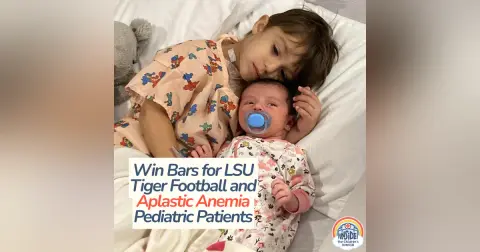
Win Bars for LSU Tiger Football and Aplastic Anemia Pediatric Patients



Key Takeaways
- Ryan Solieau shares his family's journey after his six-week-old son Henry was diagnosed with aplastic anemia, a rare bone marrow failure disorder.
- Learning to navigate hospital systems, blood transfusions, and medical terminology can be overwhelming, making trust in the healthcare team crucial for parents.
- Inspired by LSU Tiger Football traditions, Ryan created "win bars" for pediatric patients to touch on their way out of treatment, symbolizing a commitment to victory.
- Building strong, supportive relationships with pediatric nurses and healthcare staff can turn a children's hospital into feeling like a second family during long-term care.
- Fathers navigating pediatric illness often carry a unique emotional weight and need to find healthy ways to advocate for their child while processing their own stress.
During this week's episode, Katie sits down with Ryan Solieau, an LSU Alum, and dad to a Henry who was diagnosed with Aplastic Anemia. Aplastic Anemia is a rare blood disorder where bone marrow stops making new red blood cells, which appeared in Henry as a heart rate of 250.
Ryan takes us through the experience of learning a new reality during all phases of Henry's diagnoses, from learning how to navigate Henry's initial hospital stay, all the way to supporting Henry emotionally during his monthly transfusions. In the episode, we also learn from Ryan how crucial it is to take care of oneself in order to be the best advocate for Henry.
Timestamps
1:37 - Intro to Ryan
3:38 - The Hospital Experience: A Second Family
6:24 - The Diagnosis: A Life-Changing Moment
9:38 - Navigating the Medical System
13:49 - Understanding Aplastic Anemia
15:27 - The Roles of Fathers in Caregiving
18:12 - Building Relationships with Hospital Staff
20:44 - Recognizing Emotional Needs
26:40 - Advice for Parents: Seeking Help and Support
35:08 - Fatherhood and Personal Growth
42:01 Navigating Medical Challenges and Triumphs
Resources
https://www.instagram.com/rsoile6
To listen to more episodes, head to insidethechildrenshospital.com
This podcast is for educational and informational purposes only and is not a substitute for medical advice, diagnosis, or treatment. Every child and family is different. Always talk with your child's healthcare team about questions or decisions related to their care.
The experiences and opinions shared by guests are their own and do not necessarily represent the views of their employers, healthcare organizations, or Inside the Children's Hospital.
Frequently Asked Questions
What is aplastic anemia in pediatric patients?
Aplastic anemia is a rare blood disorder where the bone marrow stops making enough new blood cells, leaving children like Henry dependent on regular blood transfusions to survive.
Who is Ryan Solieau on Inside the Children's Hospital?
Ryan Solieau is an LSU alumnus and father who joined the podcast to discuss his family's experience navigating his son Henry's diagnosis with aplastic anemia and long-term hospital stays.
What are win bars inspired by LSU football in children's hospitals?
Borrowing from the LSU Tiger Football tradition, Ryan Solieau created custom "win bars" for pediatric patients going through treatment so they can hang them over their door and touch them on their way out.
How do parents manage frequent blood transfusions and hospital stays?
Families adapt by scheduling labs and transfusions strategically, leaning heavily on the support of specialized pediatric clinic staff, and organizing community blood drives to combat shortages.
0:00 Are you wondering what college football and aplastic anemia have to do with one another? Well, I don't want to make you wait anymore, let me tell you. LSU fans, I especially need you to listen to this one. When Ryan Solieau son Henry became dependent on blood transfusions because of aplastic anemia, their family spent years in and out of the children's hospital. And somewhere along the way, Ryan was inspired by a piece of LSU tradition, and he brought it inside his children's hospital. So if you've ever been to Tiger Stadium, apparently you know about the wind bar, that's W-I-N bar. And Ryan started making his own win bars for kids who were going through treatment so they could hang one over their door and touch it on their way out, carrying that same message with them: a commitment to do whatever it takes for victory.
0:51 I can't wait for you to hear Ryan and I's conversation when he literally talks about the moment he was like, I just have to create this for my kid and I have to do it for other kids too. He started just by bringing them to kids at Henry St. Jude Clinic, and now he sends them to families around the country. So LSU fans, do your thing and share this with other LSU fans. This episode is especially for you. But it's also a conversation about being a dad in the children's hospital, what repeated procedures can do to a child, the people who become family along the way, and what happens when one's family's very difficult experience actually turns into a way to support the next. Let's Geaux Tigers, and of course Nittany Lions, and go ahead and listen to my conversation with Ryan.
1:37 Well, Ryan, why don't you introduce us to a little bit about you and who you are, a little bit about you, Ryan, and ~ where you come from. Okay, yeah. ~ Ryan Solieau originally from small town, Louisiana, Vill Plat, but been living in Baton Rouge for about fifteen years now. ~ yeah, and just have three beautiful little kids, beautiful wife. ~ yeah, living the dream. love it. That muggy Baton Rouge life. Yeah. For sure. well, talk to us a little bit about why you wanted to come here and share today and really what you're hoping that parents take away as they listen.
2:24 ~ I guess just about, you know, the hospital life and how it's ~ It it could be hectic, but it's also like it's I I don't know if our situation's any different than other people but it's like we it's it's stressful getting there and having to deal with, you know, and you you know how it is. It's it's always stressful, but he I guess that it's it I don't know. It's kind of a horrid thing to ~ put into words, but they it Yeah, I don't know. It's just been ~ I guess w with our hospital it was just it was like having a second family, really. I don't know if that's if that's answering your question or not.
3:13 It it really is and I feel like it can be like the scariest place in the world to be, but simultaneously a very supportive place to be and you can live in both worlds at the same time. Yeah, ~ Henry doesn't like the he didn't like the ER, he called it the bad part of the hospital. He likes he liked he liked the third floor with the things. Yeah. Well, why don't you take us back to ver the very beginning and figuring out that something was going on with Henry and and what you and your wife saw? Yeah, it was our situation was a little ~ I'm gonna not gonna say unique, but we it was just a normal Friday.
3:59 I think it was a Friday, it was February seventh of twenty twenty. ~ I was at work, just drinking some coffee and my wife my wife called Ashley, my wife called me and she says, you know, the Avallette monitor is going off and I don't know if you know about the outlet monitors, but yeah. So she's calling, but it's going on, it's going off. It's sounds like an alarm and a check that she said hard beat of two ~ 250, heart rate of 250. And you know, my first reaction was okay. Well, maybe just the monitors, you know. Maybe it's it's malfunction. She's like, I turned it off, I turned it back on, it's still reading 250, and I was like.
4:44 Okay, she's like, Well, I'm going to the ER at children's hospital. I said, All right, babe, like I'll I'll I'll meet you there, you know. And so I go, I tell my boss, you know, hey, I gotta go to the hospital and stuff. And the whole way I'm thinking I like I'm actually thinking was like, you know, maybe hopefully it's just a malfunction and nothing's gonna be wrong. 'Cause to that point nothing was wrong. He was just a healthy six week old little baby. Nothing was wrong. We didn't think anything. anything different. ~ and then we get to the ER, they have us in triage unit ~ or triage room. And the nurses there, they they were great. I do remember it's it's been six years, but I do remember them being like, why y'all here? Like outlet monitoring to kind of like, you know, kind of okay. You know, but then they To their credit, like they they they ran tests, they they did blood work right away.
5:44 ~ I know you hear some horror stories where they pe parents just get dismissed, but we weren't. ~ and the blood work came back about an hour, they said severely anemic. ~ they still didn't know what was going on. They said his hemoglobin was five point two and that they were gonna start ~ You know, like get us get us ready to go up to the PQ, but that was still eight hours later. We were in triage for eight hours till they could get our room ready. But that that was it. It was ~ healthy literally one second and life changed the next. Yeah, getting admitted to the pediatric ICU from the ER with a six six week old just has to throw you 'cause you're like, okay, now I'm in go mode and now I'm terrified for for my child.
6:42 Once you got to the PICU, what did they do and how did they care for you? ~ I guess I wish it's it's been so long, but I I remember just everyone's very calm. You you would think it would you would think it wouldn't be calm, but everyone's very calm to make you feel they make you feel as ease as they can, you know, just always always like say this is what's gonna this is what's going on, this is what we think's happening, this is what is happening. ~ and just ~ the nursing staff and everybody there is just great. And it might be that the hospital is brand new, like it it opened. in November of twenty nineteen and we're there, February of twenty twenty. ~ but I I I think just the the staff was just great.
7:25 ~ the only the only hiccup I think we had was before they moved us up there, they said, Hey, y'all gonna go see hematology. And then whenever we got up there, they said the oncologists are coming And me I didn't know first of I didn't know what hematology meant and I definitely didn't know what oncology meant. So I was like, So they said, you know, oncology's coming to meet you. And Ashley looked at me, she's in, she's medical. So she's ~ I let her was What's oncology? And she's you know, that's cancer. And I was like, Well, they said hematology, so they were no. It we we put it together.
8:06 It's oncology, hematology. We just, you know, they we just misspoke. It didn't say hematology. But but that was like the one hiccup that kind of got us Not really knowing what was going on. Yeah, that's so true. Of ~ hematology, oncology are usually kind of slotted together, especially within hospitals, and the doctors work so closely together, but they can feel like two very different meanings. And sometimes the words just you don't even understand what they mean, like you said. What did they discover during that hospital stay or shortly after? they just severely anemic and they really didn't have a diagnosis for him.
8:46 They ended up being idiopathic aplastic anemia after after three days. He had I think five blood transfusions in three days just to get his blood up. ~ and it was like it was like constantly give him a bag and another bag and another bag. It was it felt it was constantly being, you know, transfused just to get his blood back up. Yeah. And it was you know, it was that that's what it was, and they said, Hey, look, come back for labs in two days. You know, so we were in the hospital all weekend and right back like two days later to get labs and see where his hemoglobin was, which it was low again, so you know, schedule he go in for labs and then schedule blood transfusion the same day.
9:38 Since you kind of admitted and said out loud you didn't know a lot about medical terminology and what to expect in the hospital, when do you feel like you finally got your groove with understanding how the the system works? It it took a while and I still don't I still don't know what the word ~ especially not with like my chart. That's that's like Ashley, she's a rock star. She's the one that would take care of all the stuff because ~ I wouldn't I did like a few research when we kinda didn't know what was going on, like, it could be this, it could be this. And the first thing I looked up was, Hey, your child's gonna die and I'm like, Okay, I'm done and I'm done looking at I'll let I will let the doctors tell me.
10:25 what's going on. I don't need to do my own my own research, but that was my that was my coping or not coping, but that my hey, I don't need to be doing my own research. Yeah. That must mean you had like a level of trust with the team that was taking care of you. Yeah. ~ yeah, we love we love our doctor. And then, you know, just to be it I guess another thing comes with like saying, Hey, you're we're transferring you to our St. Jude floor, which I didn't even know we had. ~ and then being part of St. Jude, you get another sense of, hey, these are like some of the best, if not, if not the best people.
11:07 When did you kind of start to see some of the I guess the impact of hospitalizations on on Henry and really start to to see that I'm gonna have to step up and advocate for him and really find the best way to support him because y'all are all living in fight or flight mode. Yeah. it was really once we got once we got we we we had to get used to ~ you know hospital we we had to get used to going to the hospital every week. It was ~ I think at first it was every Wednesday and we were there for like ten to twelve hours.
11:55 ~ 'cause you had to get you know get the labs, get the Get the labs drawn, then have to find a match. Then it takes eight hours for blood transfusion. And then we started going every two weeks. ~ once we figured out, hey, we could do labs on Wednesday and then do do a transfusion two days later. So we're not there all day. We could they could get the blood ready. ~ it was really one once we got settled and able to probably about a year whenever we were like, hey, we need a after like the initial shock, right? And We're like we we need to do something. We need to start getting blood drives together because it's always a blood drive.
12:36 There's always a blood shortage. And then this was during twenty twenty where no one was giving blood rates. It was Well. Or it was very much it was lower than normal, right? 'Cause of the restrictions and ~ I know there was one time we one time we we waited like they had to admit us into the hospital because we didn't get the blood till like four. You know, so they had to admit us to the hospital to finish the blood and then we didn't end up leaving till like one AM. But it it it was just that. It was, hey, we need to start advocating for more like blood drives and just ~ so that's what we did.
13:21 We d we we we made a blood drive, we did a a jambalaya fundraiser blood drive and the fundraiser was for the clinic that we that we see, try to raise money for you know for them. Yeah. I wonder if because you've gone through the process yourself, you can kind of help explain what aplastic anemia is in your son's case and how do you explain it to like your family and friends to describe his diagnosis? Yeah. The the easiest way is you you say bone marrow failure and then the next thing's like, well, okay, well, what's bone marrow failure? It's he he can't create his own blood or he couldn't create his own blood.
14:01 ~ and I was pretty much across the board, it was mostly it was mostly red blood cells that he couldn't his his baby blood cells were dying off and not being replenished. Or he wasn't replenishing, he was his old cells were dying off, wasn't replenished anymore. ~ and it's mainly the red ones. So that's that's basically what we say. We we tell people, yeah, he can't create his own blood, and then so he's reliant on blood transfusions to live. ~ and then you you kind of just have to be frank about it. Like at first at first it was like, you know, this, but then it's like, yeah, when I'm telling people, yeah, I was like, he he needs blood, he needs blood transfusions to live or he's gonna die.
14:41 ~ Yeah. it's it's it's i I feel it's better to just to be frank right to the point. Hey, this is th this is serious, you know, it's not it's not like Yeah. Sugar coating. Right. I feel like I've talked to some other dads on the podcast who often carry a weight that is unnoticed, of kind of having to be the strong one and just like your wife is too, in a different way. Have you talked to other dads or caregiving dads about what the experience of like is being the father figure in a family when your life is turned upside down by a children's hospitalization?
15:27 No, n not really. just because we I have ~ I would love to talk to some, but we we just n I I guess just never in my my experience have I had the opportunity, I guess. ~ you know, when when you're at the hospital, it's kind of like you you see another another family there and it's ~ it's like hey you're you know, they're usually in the infusion side or they're you we're my case we're at the St. Jude Clinic, so a lot of the kids are getting like their chemo and it's like we just wait, but also you you don't want to be you know, you don't want to be with them in their in their little pod. You want to be in your little pod too. So yeah. ~ we just we we've we've made friends and stuff, but we don't really talk about the the experience, if that makes if I'm not answering your question.
16:15 I've I've listened to a lot of podcasts and I've listened to the to the dad's point of view and stuff and I I agree with a lot of their stuff. ~ you know because It is it is I don't know, it's it is different. You know, like Ashley took care of the she had a lot of the scheduling. She had a lot of stuff on her plate. ~ so I was just there to anytime she needed something else, I would I'd be the one, hey, I will I will take off work to go and be in in the hospital and it worked out because I was able to take to switch my work schedule. To be able to be the one that, hey, on a Wednesday, I on a random Wednesday, I could be the one to bring them to labs.
16:57 I could go in late. then the way it worked out, we would schedule it to where I was off on the days we get we needed the transfusions. So that yeah, it was we we made it work, we you know. Yeah. But but to your to your original question, I I don't really think I've spoken to any other dads. Do you feel like that's part of the reason you wanted to come on and talk about your perspective? Yeah, it it could be. ~ you know, come the the definitely that perspective is way different, you know. And you guys have other kids at home, correct?
17:40 Yes. Yeah, we have a ~ a three year old girl and a six month little girl. Just had her. Okay. You mentioned ~ when we you filled out the form before that eventually this Saint Jude clinical staff became your extended family, so much so that I know your son had like almost like a special name for the hospital floor that he would go to because it was the name of his first nurse. Tell me a little bit about that. yeah, he calls it he calls it Neek's house. So anytime we pass by the the hospital, it's ~ it's really pretty if you've been through through Baton Rouge.
18:24 it's you you're on I ten and you're going and and it's the children's hospital off to the side and it's ~ it's a it's a really pretty building, you know, it's anytime we go by he's looks at it and he's like, It's Neek's house, it's Neeks House. But yeah, buddy, it's you know, and he we always say, we gotta go to Neeks House for for labs or whatever and you know then he says like I don't want to go to the I don't want to go to the to the bad part of Nick's house, which is the ER, which we talked about. ~ but yeah they they became our our our family. ~ even ~ yeah his first whenever we were but they were trying to get him an IV the very first the very first day whenever whenever we went in they couldn't get an IV he was he was Dehydrate, not not dehydrated, but it's mean six-week old veins.
19:16 You can't. So they actually called up one of the nurses. They said, Hey, well, they told us early, hey, look, we're getting someone with 20 years experience coming in because they couldn't, they his little his hands were just all beat up from the from the sticks. And ~ yeah, Miss Joan came in and she looked at him, looked at him For first thing she boom, just she's like, we're like, thank you thing. And she's like, you know, I I've been doing it for twenty years. you know. Wow, she's like, I'm the one they call when they can't get an IV. And then we didn't know it at the time. ~ they just said upstairs. They didn't say, you know, whatever. And then they transferred us to the PICU which I think was like the fourth floor, fourth or fifth floor.
19:59 ~ and then like two days later, that's when they said, Hey, we're gonna be on the on the St. Jude floor for the, you know, for the rest of his treatment. But just so that was our first experience, right? Was the first, the first Ms. Joan, the first nurse that got him his first IV stick when no one else could. And then to have n ~ Monique was the one who like took care of his little baby, you know. They they grew up or he grew up he grew up in the hospital and they grew up they used they watched him grow up to, you know, it's It's ~ yeah. It's just I don't know.
20:44 Yeah. One of the other things you said was that at some point he stopped crying when he got poked. And that that was, you know, you kind of anticipate you want your child to not cry during a poke or something like that, right? Because you don't want them to feel the pain. But then there's the other side when they've endured so much and they just stop crying because they're getting poked and because they're used to it. And that was kind of a moment for your family to realize we need some extra psychosocial support. Can you speak a little bit about that?
21:43 Yeah. ~ One thing they don't tell you. ~ It's a I mean you you expect them to cry when you're holding down. ~ don't expect them not to cry to get poked 'cause they're they're expecting it. And that really happened with his with his port, because you know we had to get the port in for to make his his the medicine he was taking at the time just easier to access access because his ~ three years of getting IVs in the wrists, his ~ his veins were beginning to valve, so they weren't able to get it.
22:29 So they'll like look the best best course of action is to get a port in. ~ it just you know. Quality of life would be easier, you know, besides the fact that, you know, every time he got a fever we had to go in. ~ but that's you know, that's the the the port was the best thing to happen. ~ it was you know, it except whenever the he it took about maybe a month and him just screaming, screaming, then he just he would just walk up and like sit he would just Or he they had him in the chair for the port, but he would like lay down in the chair and just you you kind of see his face.
23:10 He would like leap lean back and his face would just like like a shadow, like shadow would go over his face and he would just wait for it. And you know, there's a team of four nurses in there because you have to, you know, people don't know about the about the port, but you have to you know have to be a as sterile of an environment as possible to have to clean it and everything. So there's always like five nurses in there and they all have they all have their masks on, you know. That's not It kinda it's kinda scary for it, you know. ~ so and then he he's just sitting there and just ooh and then poke and then okay. Or that that's it. And like the first time that happened, like me and Ashley kinda like looked at each other like, you know, and then we know you tear up 'cause you're not expecting like, okay, now it's just horrid of he's just accepted it like like you were saying, it's just not not not something you would expect.
24:05 And then and then it's like, you know, it's he's dealing with it so well, but then ~ internally he's not. 'cause that like what what you're alluding to with the ~ ~ mental aspect of it, he he was having trouble at daycare, like not listening. And we weren't really seeing it at at the house. I know like something would happen and it was like, is it just a toddler not getting his way? But ~ one of the nurses at St. Jude said, Why don't you why don't you get him to go see the pediatric therapy?
24:45 ~ that he got him analyzed and he had I forgot the medical term for it, but it's like he was stuck in he was stuck in fight or flight. So Yeah. he had to deal with so we deal with dealt with that for about two years of him going to therapy to to get out of that. To get out of that ~ that rut he was in because you know, six weeks old getting poked every week. Yeah. It you know his body never ~ what did they describe it as? You have a little baby and we just went through it because our our daughter's six months old, you they have this little this little like jitter kicks, whatever. He they they equated it to he never got out of that.
25:36 Like you're supposed to you're supposed to grow out of that in like six months. Well, he never grew out of it. So his body was either it was fighting with itself to either be at at rest or completely one hundred like I gotta I gotta get out of here 'cause I don't know. I don't know if this thing you're telling me no at home, like hey you can't touch that. Are you are you then gonna, you know, poke me or get me, you know So that's his his brain was anything, any discomfort is gonna be met with like something he doesn't want to do, some kind of sort of pain and so But he we Yeah. But we we ~ the the pediatric therapy that we went to, they were they were great. And ~ and he's doing he's doing really well now.
26:28 What would you say to another parent who's watching their child kind of have that flight response? What would you recommend that they do? Definitely definitely get it checked out. ~ like have him go go to a pediatric therapy clinic and have him check it out because it it it did wonders for for us in home life too, because he would he we and then we could see it w him working through his His stuff work like work working through his own emotions and things. It 'cause it it just calmed everything else down because it was always the slightest little thing might set him off and then it's then then you start getting stressed 'cause he's like, I didn't you know, so it's you're trying to have a Right.
27:18 So definitely if if anything's and it it trying to explain it. His his behavior wasn't it it it's very much like is it just a two year old at the time, you know, 'cause he whatever. It's like he's six now, but like at the time it's is it just a two year old not getting their way? Or is it something we're right? So that was something very, very much like we ~ we had to realize what it was. And and then it took it took an outside source. Like it took it took his daycare teachers saying, Hey, this is what's going on. And then we talked to our nurses and it's like, Well, this might be this, you know.
28:00 Yeah, it's it's so important to have like these conversations with the trusted adults around your kids too, because some I've seen this too in like siblings, although they're not the ones being poked, every time something does happen, mom and dad leave, go to the hospital and it's just always good to have these extra eyes of people who love your child and your family to say like, Hey, something I'm seeing this Have you thought about getting this type of support, et cetera? Yeah. I feel like there's you also talked to me a little bit about the win bars that LSU and the the victory campaign on Facebook. Can you speak to that a little bit?
28:50 Yeah, that's that's something I I started doing as a ~ We you know, 'cause we were around that time, I think it was like twenty-three, in his treatment, we were in the hospital every twice a week, twice a month for four days. Like we would go in on Friday, leave Monday night, ~ for his treatment 'cause we were trying to get his levels down for bone marrow transplant. But then he had his iron off of his off of his ~ liver. So it was just we're doing this big thing and and we were just there and So you're in the infusion side on the the way the the hospital the way the our hospital is. The third floor you have the you have St.
29:34 Judes clinic on one side, then you have the infusion side on the other side. And ~ so it's us there every other week. So you start seeing all these other St. Judes patients and the kids, you know, the the you know they're I know some people think you know you're at a hospital and you just have to stay in your room, but it's like very much you could walk around with your with the IV poles and stuff. You could walk around a little bit where you are. And I just had this this idea. ~ I told the Ash was like, I was like, what if I start making Win bars and giving them to every time we come in, every week and we come in, I can bring like five and whoever's at the clinic or whoever's at in on the infusion side.
30:21 We could go and Henry could go and deliver it to him. And so that was that's that that's basically it because I was you know, then I had to figure out how to do it the best way best way to do it and you know, find all the materials and and stuff because ~ i people may not know what the L shoot windboard I was just about to say you have to for for our non LSU Tiger fans, what is a win bar? So the the Win bar is a so we're in Tiger Stadium before the football games, it hangs. It's a it's a the ri the the original one is a goalpost from fifty eight to eighty five. That when they they got new goalposts, they put they just put this section of goalposts over the locker room.
31:06 As they're wall as so every player that runs through the tunnel into Tiger Stadium, they hit this goal post that just it has painted on it purple and gold just says win. And there's a plaque over it that says, you know, in Thank you. Don't know what it's like, I don't know the full thing, but it says, you know, basically that it's a this goalpost stood in Tiger Stadium from 85 from ~ 58 to 85 and it represents It represents the threshold in a Tiger Stadium that, you know, a commitment that's the the the last line, sorry, rambling on. The last line is it's a sign of commitment.
31:49 Okay. Yeah, yeah. It says it's a sign of commitment to do. A sign of commitment to do whatever it takes for victory. So that the idea was.
32:31 Give these kids It's fine. You know, they could Hang it above their hang it above their their door frame. So when they're going for treatment, they go in the Yeah. Yeah. Sorry. my god, I love that. So and ~ each one each one's blessed. ~ I get like I get like twenty at a time and I bring to our to our church and I get our priest to bless all. So Wow. yeah. That's amazing. Yeah, so ~ yeah, so I started that.
33:13 I started that just for them and then I started mailing them around mailing around the country. So my gosh. It's a ~ a joke that it's a one big recruiting tool. To get him to to get them to come to LSU. That's the No, Ellis need L S U needs to start paying you. Right, yeah, right. man. Yeah. That's amazing. I'm so glad that you acted on that idea. That like creative Yeah, and it's ~ it's it's it's it's kind of a weird thing to get, right? ~ I know it it open it up, it's a the ones I use a two foot just thing, it's just a P V C pipe, right?
33:59 With painted Win on it. ~ it's very I know me Mr. Mark, you say it's a very it's a very novel very not novelty thing to get, so I love it, but it's like a nod to where you're from. Does Right. does LSU know you've been doing this? I don't I don't think they do. ~ I know I I tag in the in the post, but I don't I don't know if they if they do. Yeah. ~ One of the things that I find most amazing about you, Ryan, is just how lucky like Henry is to have you as his dad.
34:39 it's not easy to come on and talk about the hardest moments of your life, but I can tell that you're doing it number one because awareness about aplastic anemia and what families go through needs to be understood, I think, by the general public. And the second part is that I can tell that you just love him so much. What are what are some of your favorite parts of being Henry's dad? Yeah. And it was with a cliched answers like watching him grow up, but yeah. He he he's so funny. ~ you know, we I it's the story I like to tell is we're I was picking up from daycare one day and we're driving home and ~ I had just I had just shaved my head for St. Baldrick's Foundation and we were driving and ~ he saw this he saw this this bird outside, it was a It was a it was a vulture, but he was like, Dad, it's a it's a it's an eagle.
35:44 I was like, it probably is, but it's an eagle. He's like I was like, What kind of eagle is it? He's like, It's a black eagle. I was like, yeah, black eagles are cool. He's like, No, it's a bald eagle, like your head and I'm like and I'm just like, you what? I like Like So he he he's very quick witted, which is good. and he's he He ~ He loves he he loves so much. He's so good with with Piper, the our our youngest. ~ he wants to take care of her. He's it's it's his she's her she is his baby. He he's just a big helper. ~ you know, he he has his he has his he has his moments, he's sick, so he has his ~ his attitude moments.
36:33 Yeah. Hope them too and I'm forty, so Yeah, for sure. But no, he he's ~ he shows he he has interests and I just love I'm trying to get I just love I love trying to like just foster his his interests and stuff and he he loves he loves like painting and art and ~ he's in piano, so So cool. yeah. What are some of the things you've learned about yourself since becoming Henry's dad that you may not have known before? maybe on like the ~ I don't know if it's gonna be like a negative or not, but I know I ~ deal with stress differently.
37:15 ~ I kinda do the ~ the retail therapy, ~ dealing with stress. What is your d retail drug of choice, Ryan? Well I ~ board games. I kinda went crazy. Yeah, I kinda went crazy with the board games and they're not cheap, so I kinda Yeah, that's amazing. It's a ~ it's a Star Wars it's one of those Star Wars games. It's a ~ board game, yeah. I love it. so I d I I kinda went crazy. I bought I bought a whole bunch whenever we were going through it. And then ~ maybe that was my My coping mechanism was like, let me buy all these games.
37:56 You're like, Yes, these will make us happy and feel good. Yeah, exactly. And then and then they just stayed in the closet. Right. ~ my gosh. But I on a I guess on a positive note, it's that So we we I mean, I guess me me and Ashley together, we ~ like we've been through the like we've been through that and that was that was we we've been through and that was our, you know, six year we still dealing with it not as much, but we could go through that, we could we get through anything. So Is his treatment protocol as intense as it once was or No, not at all. ~ we the thick of it was late twenty three. ~ thing. ~ yeah. Yeah, he's been three years transfusion free.
38:54 So it'd be he'll be three year three years in May. So his last transfusion was twenty three. It was a It was ~ he had a transfusion in February of twenty-three and had a reaction. First time having a reaction in in three years. And ~ talk about, you know, hospital staff. ~ I was I was just looking at him and I was like, he wasn't looking the same. I was looking at him, he he he started he was all red right here and looked at his ear, his ears started getting puffy. And I I kind of just like you know, let him be in the in his chair and I'll I walked up to the nurse's station.
39:39 It's in you know in the middle. And I was like, hey, ~ something's not right. And and I'm very like not I'm very like very oblivious to a lot of things. And I was like, ~ something's not right with Henry. Like his ears all red. And so like nurse walks in and she's like she looks at him and then she says I don't remember what happened. She said something and the next thing I know there's every person on the floor is in our like five Yeah. by five ~ cubicle basically and I was like I don't know what's going on so I'm like in the corner and they're like going there so he they were like we just have a reaction so they gave him some an epipen some Benadryl ~ and they stopped the transfusion.
40:24 We'd only been there for like two hours and they said we you know ~ we're not gonna transf we're gonna stop the transfusion today. I think we set it for like the next day or a couple of days to come back and re re-get his labs done and ~ see where he was. So that was in February and then he we got his ~ transfusion then again in May because he was on he was on like two months every two months at that point because it all depend depended on his hemoglobin. ~ in May he had his last transfusion ~ and we were scheduling to go we were scheduling to go to Memphis to the main main campus St. Jude and ~ they had us all like pretty much set up like hey we're gonna do the a bone marrow transplant and we just have to make sure everything lines up.
41:18 ~ but his his hemoglobin kept on holding and holding and holding and never it never dropped below the I think he's still at like nine, five or something like that, and it's never his threshold was at the time, I think like eight and eight. And it never dropped, never dropped. And our hematologist was like, Look, I was like, I if he doesn't drop, I don't know, don't see why we need to go through with a transplant if he's holding. So now it's yeah, three years later we're we're still he's still at like nine five with his hemoglobin. But ~ his Wow. his treatment now is monitoring his ~ labs every three months.
42:01 Okay. So Amazing. Well, thank you so much for being willing to come on and share about your family's experience and what you went through. Were there any other questions or stories that you wanted to talk about or have me ask you? I wanted to shout out one of our ~ the child life specialists that was with us. her name. I I'm gonna say Elizabeth. I'm pretty sure name was Elizabeth. And ~ like I said, we would go in on Wednesdays for labs and Fridays for transfusion. And we were like one of three patients on Fridays. ~ because Fridays was kind of like their the clinics.
42:45 I guess I'm g I'm I'm gonna say paperwork day, like just get all the files and you know, not a lot of not a lot of patients except for us 'cause it took so long for us. Like it takes it takes eight hours on a good day for a blood transfusion. So ~ we would go and I and she was a she was a child life volunte volunteer. So she was still in school for early childhood development. And she would stay she would stay with Henry. In the room, like she like, she would tell me to like Ryan. She's Ryan, go go get some, you know, some lunch or whatever. And she she would stay in our room with him for like four, four to five hours. ~ to the point where like we would go and we would ask, like, is it is Elizabeth here?
43:32 Like, Henry wants to be with her. So she was she was amazing. ~ and like and we went, it's been, it would be it, it had been a couple of months or whatever, and we had gone. We had gone back and she was just in like the the little player room and we walked in and she was there. She was like, Henry you so she remembers him and he it was yeah. So I just wanted to give a shout out to Child Life. ~ Thank you. I it sounds like you can't forget a kid like Henry. So Mm-hmm. wonderful. Well, thank you so much, Ryan. I know we didn't touch on the insurance part of everything. Which is would probably be a whole other podcast, but is there something you wanted to add is there something you wanted to add about that?
44:16 No, I think we all know. We all know how dealing with insurance is. It's For those guys. Yeah, right. They ~ I guess the only thing is they they didn't they didn't they didn't like We tried to I guess we tried to warn them that hey you're gonna have to pay for our at home treatment or you have to pay for hospital stays and they chose hospital stays for about four months and they're like, you know what, we're gonna let's not pay for eight days of infusion infusion charges. Yeah. Yeah. Well, thank you so much, Ryan. If people wanna follow along or learn more about any of the resources that you've liked, where where should people follow you or what are your favorite resources to share?
45:03 The ~ I guess like you follow me, I guess I don't know. I have a I have a I have a Facebook page for the the Win bars for the it's the victory campaign on Amazing. Facebook. ~ and then Instagram's just my name. I like I said for the as far as the as far as the victory campaign I'll I'll ~ I'll mail ~ just send me a message, I'll make a Win bar, mail it to whoever. ~ yeah, that's about it. I love it. Well, thank you so much, Ryan. I appreciate you. Yeah, thank you so much. Before you go, if this story taught you something, made you feel less alone, or helped you better understand what families experience in pediatric healthcare, would you help us by passing it forward?
45:50 Podcasts like this grow because people share them. Send an episode to a friend, a neighbor, another parent, or share it with a Facebook group or community where you think someone might need to hear it. And if you haven't already, follow the show and leave us a review. it helps more families find these stories and learn from the parents who have walked this path before. Thank you so much for listening to Inside the Children's Hospital. We'll see you next time.

