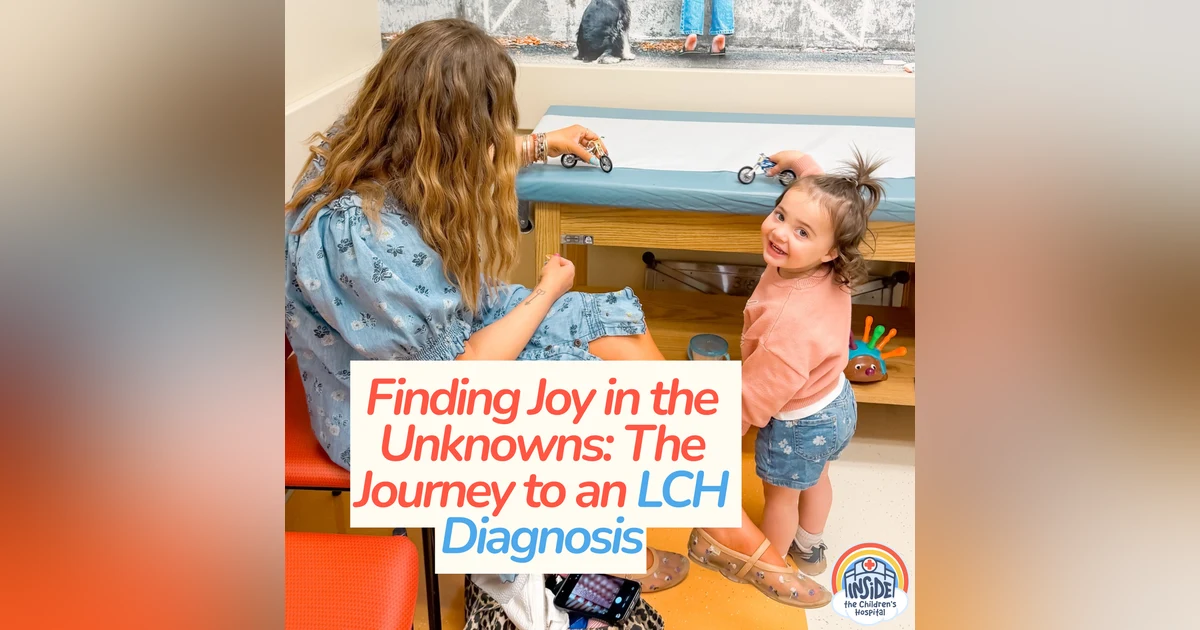
Finding Joy in the Unknowns: The Journey to an LCH Diagnosis


Key Takeaways
- Katie Cangi shares her family's emotional journey navigating a rare LCH (Langerhans Cell Histiocytosis) diagnosis for her young daughter, Lola.
- An initial misdiagnosis of a bone cyst and hairline fracture highlights the importance of second opinions and specialized pediatric orthopedic care.
- Connecting with other families online helped Katie Cangi feel less isolated and realize that initial fears do not dictate the entire medical journey.
- The diagnosis process involved comprehensive imaging, a needle biopsy, and eventual transition to an at-home oral chemotherapy treatment plan.
- Balancing the needs of older siblings while caring for a medically complex child requires immense resilience, support, and intentional time management.
Katie Taylor sits down with Katie Cangi, mom to 4 and medical mom to her youngest, Lola. Lola was Katie's first NICU baby, and for nine months she was a happy baby, till it became harder and harder for Katie and her husband to calm her down.
Both Katies traverse through the diagnosis process, as Katie C. attended multiple doctors visits in order to figure out Lola's LCH (Langershans Cell Histiocytosis) diagnosis. Finally getting the answer, the hospital became the family's second home, and Katie gives us an understanding of how she, along with her family, were able to find the little joys in their new atmosphere.
TimeStamps
1:29 - Introduction to Katie's Journey
4:22 - Lola's Diagnosis
7:15 - Understanding LCH
10:14 - Navigating the Diagnosis
13:12 - The Impact of LCH on Family Life
16:25 - Navigating Treatment Decisions
22:12 - Coping Strategies for Caregivers
25:29 - Managing Hospital Visits
29:29 - Supporting Siblings in Medical Journeys
31:31 - Finding Joy Amidst Challenges
33:18 - Reality of Medical Parenting
Resources
To listen to more episodes, head to insidethechildrenshospital.com
This podcast is for educational and informational purposes only and is not a substitute for medical advice, diagnosis, or treatment. Every child and family is different. Always talk with your child's healthcare team about questions or decisions related to their care.
The experiences and opinions shared by guests are their own and do not necessarily represent the views of their employers, healthcare organizations, or Inside the Children's Hospital.
Frequently Asked Questions
What is LCH (Langerhans Cell Histiocytosis)?
LCH is a rare condition where the body produces too many white blood cells, which can form masses or lesions in bones, skin, or organs, causing pain and potential dysfunction.
How was Lola's LCH diagnosed?
After noticing pain during diaper changes, Lola's parents sought medical attention. Initial x-rays suggested a bone cyst and fracture, but further review by specialists at CHOP led to a needle biopsy confirming LCH.
Is LCH considered a form of cancer?
While LCH is a rare disease and not technically cancer, it is typically treated by pediatric oncology specialists using protocols similar to cancer treatments.
What treatment did Lola receive for LCH?
Because the LCH spread from her right femur to her left hip while remaining in the bones, Lola qualified for and was treated with at-home oral chemotherapy and steroids.
0:00 Hello, my friends. I'm so happy that you're here today. Today I get to introduce you to another Katie. She is mom to Lola who has LCH, Langran cell histiocytosis. Katie was searching when her daughter was nine months old for other families who had LCH and could barely find anything. She was trying to find it through hashtags. And so she started sharing online. Once she started sharing on social media, She started connecting with families all around the world who have kids with LCH. And that's exactly why she's on this podcast today. She wants you to know that the way you feel in those first few weeks are not the way that you're going to feel the entire time that you're navigating this diagnosis. That's incredibly scary.
0:42 Katie has three older kids, and so we talk a lot about the balancing of siblings, how she works with her partner, her husband, as they support her daughter through treatment. And What her outlook is now, that they are almost a year into treatment for LCH for their two year old. We also talk about the diagnosis story. So how she found out that it was LCH. And actually, it was a wrong diagnosis at first of a hairline fracture, which had their doctor not sent off the film, her daughter daughter would have been casted the next day and the diagnosis wouldn't have been found. So I'm so glad that you're here. There's so much goodness to listen to. Welcome to Inside the Children's Hospital.
1:22 Let's get started. well, welcome to the Katie and Katie show. We're happy to have you here. Yeah. ~ in my previous life, I my last name was a different last name because I was married before and it started with a C. So we could have been Katie C's. You really could have been. ~ But it's fine. We'll just be Katie C and Katie T. But Katie, tell me a little bit about you, where you're from, ~ what brings you here, and a little bit just about you, Katie. Yes, so I am Katie and I am a mom of four. ~ I live in Kennet Square, Pennsylvania. It's a small town outside of Philadelphia. and I lived a very average life. My ~ husband and I are middle school sweethearts, so we've been together for a very my gosh.
2:06 long time. ~ we started, we lived in Philly for a little bit, had our first two babies in Philly, and then we moved back to Kenneth Square, which is our hometown. and had two more babies in Kennett Square and just were normal, you know, baseball fields, gymnastics classes. And then my youngest daughter Lola ~ was diagnosed with a rare disease at nine months old. ~ and that has really changed our lives. Yeah. And were you a teacher at well during it were you a teacher as well during that time? I was not. I taught in North Philly for about ten years and I had my first two LROs and Nikki ~ in the city and I was a teacher during that time.
2:49 And then COVID hit and ~ god. COVID changed a lot of things and I never went back after COVID. Okay, so do you have any boys or all four girls? So Ella Rose is my oldest, she's a girl, and then Nikki and Mac are my middle two and they're boys. And then I have Lola. Her name's Magnolia and we call her Lola and she is our youngest and she's a girl. So two and two. Yes. Okay, love it, love it. Well, you know, I'm Lindsay ~ found you on the podcast. For anybody who doesn't know, Lindsay is our amazing producer and editor of the show. And her and I have been doing this together for a very long time. And what I love about Lindsay is she is such a connector ~ on social media. And she and I will end up finding these amazing moms and dads and these accounts that are just so honest about what having a child with a rare disease where a diagnosis looks like.
3:41 And Katie, you're one of these people. And Yeah. do you mind kind of taking us back to the beginning to finding out that something was going on with Lola? And it's like your fourth child. So you're expecting everything to just What be as routine as it it was before. She is truly our medical child because I was induced with high for high blood pressure. I wasn't totally pre-clampsia, but I was trending in that direction. So I was induced. ~ and then she ended up having about a two-week stay in the NICU just because our labor was so fast and she had fluid in her lungs and it was nothing to do with LCH. But ~ she was my first NICU baby. So ~ so she's a truly our medical child. So Yeah. she started in the NICU for two weeks and then home healthy, never had any issues.
4:25 and around nine months we started notice like diaper changes and getting her dressed. She would cry and be upset. And my husband actually noticed it and was like, I think she's having pain in her legs. And I was like, I think she's just tired, like, I don't really know. so we just kept keep an eye on it and it was definitely every time we would change a diaper or anything, she would be very upset. So we're like, Okay, there's definitely something up. ~ no bruising, no swelling, like nothing. But you could tell that she was very uncomfortable. So we had ~ her well visit in a few days. ~ so like we'll just bring it up at her well visit. we went to dinner the night before her well visit, and I remember getting her out of her height chair and I had bumped her leg like on the bar and Yeah.
5:09 I can still hear her cry. And she's like a very happy baby. And it took me so long to get her calm down. And that was like when Mike and I both knew something was very wrong that like she was in a lot of pain. So our next vis or our well visit was either the next day or like, you know, just a few days later. So ~ Mike actually brought her because I was doing the school drop offs and all that kind of stuff. ~ And we had assumed that we would probably be sent for x-rays ~ just because it was so tender. so we brought her to the well visit and we were sent for x-rays and we went down, they x-rayed her and within I mean it was so fast, maybe two hours, we had a call back and they originally said that it was a bone cyst with a hairline fracture.
5:59 And ~ we're like, okay, like What do we do? Like we didn't know what that meant. And they sent us to ~ CHOP KOP, which is little bit closer than like the main CHOP in Philadelphia. And we met with a bone ~ cyst specialist Dr. Wells and he showed us the x-ray and he showed us where the like originally thought it was a cyst where the cyst was and he had a big red ~ arrow where the hairline fracture would be and we were fully he was preparing us that we were gonna go to the main CHOP hospital the next day and ~ she's gonna get casted and a bone cyst is common and it you know, it will resolve itself and everything's gonna be fine.
6:39 so we leave ~ with Dr. Wells and we're on our way home and we're Mike and I are like still kind of spiraling thinking like a bone cyst and a broken leg is still kind of serious. Like we were freaking out. And we are driving home and we get a phone call and it was the a chop number. And immediately like I knew something wasn't right. I'm like, why are they calling us? So 'Cause you had just left the appointment, right? Yeah, just at the appointment. This was like maybe a half hour later, we're on our way home. Okay. And ~ it actually called Mike's cell phone and my husband. And Mike picks up the phone and it was actually Dr. Wells. So he put him on sp speakerphone for both of us.
7:21 And that's when we knew right away that like something was really not good if Doctor Wells was calling us. And he had explained to us that he sent the X rays x-rays to Doctor Arcader, who ~ We now know very well, he is Lola's ~ orthopedic specialist. And he had reviewed the x-rays and he did not see a hairline fracture, and he was rather certain that the cyst was actually a lesion. And this lesion is very different than a cyst. ~ and he over the phone had told us that Dr. Ocatur has very strong ~ feelings that it's LCH, which is a rare disease. So that's how we left.
8:03 disappointment. We were in the car together and we were still had the appointment to see him the next day ~ at Chop Main. But I remember just like driving home and we were just spiraling. We were Googling, asking, you know, Right. 'Cause you're like L C H I've never heard that like what will you chat. talk a little bit about what L C H is, like in a way that somebody who's never heard of it can understand? Yeah, so I hope I do my oncologist justice because I know this is but Yes. I'm pretty sure. It's your body produces too many white blood cells and those white blood cells form a lesion, which is the technical word is a lesion, but it's like a tumor for anybody. So it's like a mass or something where it's not supposed to be.
8:44 So in Lola's case, she has it in her right femur and then it spread to her left hip. but it could be like LCH of the skin, it could be in your pituitary gland and organs. so it's just it's like a mass of white blood cells and it causes pain and if it's in an organ it to not function properly. So, Wow, that was a so I just can only imagine that ride home. And it's like on one hand, you're grateful that as soon as he knew he called you to tell you. And on the other hand, you're like, what do we do with this? Yes. And I do think Dr. Wells over the phone did say, Don't Google it, like you'll get answers tomorrow. But like we had twenty-four Course of Google.
9:26 hours, like of course you were Googling. ~ but yeah, so it was ~ just we went okay, just whiplash, a healthy little girl. We knew something was wrong, but nine month well visit to bone cyst, broken leg to never mind, it's not broken, and it's actually a rare disease. So the next morning. One of the things you wrote to me was that one you wish you could tell yourself, like probably at that moment, you don't have to figure everything out about LCH like tonight, right now. Yes. Because we were definitely trying before we even had a a legit diagnosis. We still had to do the biopsy and all that kind of stuff. And ~ we just like wanted answers and everything you see online, you see like the worst of the worst and We were just like, my gosh, like we're never gonna survive this.
10:16 Like, what are we gonna do? She was our youngest. We were, she was only nine months, so we were still like, you know, in the kind of baby stage, and we had three Right. older kids. And my oldest was in kindergarten, and we had a kindergartner, a preschooler. Mac was home and then Lola was home. And we're just like, my gosh, we were just in such a big life transition with the bigger kids that this just really threw a wrench and everything. And we were just trying to figure out. Trying to find all the answers. Can you walk us through the diagnosis process that you talked about, like biopsy labs, getting the actual diagnosis, and maybe some things that you didn't know to ask or advocate for then that you know now? Maybe to think about that mom who just got the LCH call.
11:02 What are some things she should be looking for or thinking of? ~ so I do think we were lucky in the sense, ~ if Dr. Wells did not send that to Dr. Arcader, like he is the LCH bone specialist at CHOP. ~ and if he's if we weren't supposed to see Dr. Arcade and was just some other doctor, she would have been casted the next day and she we would have thought it was a a ~ fracture hairline and a bone cyst. And when it spread to our hip, we would have been back to square one. Like we were are very lucky that they knew what it was right away. And ~ we had March 17th was her well visit. And by March thirty first, we had like that was the biopsy results on March thirty first.
11:48 So within that, not even not even a month, we had a definite rare disease diagnosis, which I feel extremely lucky for because I know that it's very rare, especially with rare diseases and just in general. ~ so yeah, so After we the next day we went down to see Dr. Arcader and he showed us the X-ray and he explained to us why he thought it was ~ a lesion and not a cyst. And like it's so technical. they all look the same in my eyes. Yeah. It was just fascinating. He was showing us like the outline of it, how it's this way and that way, and how the inside is this way and how the bone shaped. So he was very confident. And we left that next day, March 18th with a biopsy date.
12:32 Which they got us in so quickly. We were, I think, the next week and ~ she had to be put under and they it was a needle biopsy. They took a portion out ~ of the lesion and it showed up that it was that it was L C H. So that's when everything really started. Once it was positive for L C H that's when ~ like everything else, like it was just like one thing after another. So LCH is a rare disease. It's not cancer, but it is treated through pediatric oncology. So we got a phone call within 24 hours from the ~ CHAP oncologist office and they sent us like a welcome packet and we had our first oncology appointment ~ and met with Dr.
13:14 ~ Hogarty, who we now love and see all the time, know him too well. But Yeah. ~ That's when like our oncology journey really started. ~ and at first, since it was only in her leg, he well, we didn't know that at first. So he sent out a full body skelet skeletal survey for x ray from head to toe. We did MRIs, imaging of all different organs. We did an ultrasound. I mean, we were at CHAP like weekly f between like probably for a month and Everything came back clear, which was another huge blessing. We felt like we had won the lottery. It's only in her right femur. so we were able just to do like the watch and wait game, which was a blessing and a curse because you're Yeah.
13:58 just like, Wow, we we didn't yet to start medication. Like we were followed by oncology, but just in case, ~ we left and everything was clear, could live a normal life. ~ we had to be careful because she was at a high ~ fracture risk. So we just had to like be careful with you know, high impact activities and stuff like that. She was at this time, like not ten months old, just learning to walk. ~ so that was a little bit nerve wracking. Yeah. But ~ So we felt great. And then about two months later, we noticed she had a lot of trouble like bending over and she was falling a lot more and she started to like decline in what she had and she wasn't able to walk up steps anymore and she would get into the squat position and kind of face plant when she could get up before.
14:48 So that was like another red flag, and I was like, my gosh, like something else is not Yeah. right. ~ so we put a call out to our oncology team and they sent us immediately for x-rays, and the x-rays were clear, so her hips looked great. ~ but they knew that there was a lot of like how the hip is built, there's a lot of hollow areas, so x-ray doesn't always pick up everything. So they sent us for ~ an MRI. We've got in the neck the following week and it did show a few spots of LCH in the left hip. So now she it spread from her right femur to her left hip. So you can have LCH multisystem, which is bone and skin or bone and and organ.
15:33 she is still considered single system because it's just in the bone, but now it's you know, it's spread, so it's two places. ~ so now treatment is warranted. So I remember once again, just like I knew right away, I'm like, my gosh, like this means chemotherapy. Like we're once again, we're never gonna make it out of this. This is just Yeah. like awful. And when you think of chemo th well, when I think of chemotherapy, I automatically think the port, like the Yeah. worst of the worst. ~ And we got the results of the MRI on a Friday afternoon. So I remember Mike and I just calling the nurse's line like a hundred Yeah. times. Like we had we wanted to get in touch before five o'clock.
16:15 Like we think we needed to Yes. talk to somebody. And I had left a message, Mike had left a message, and they called us back at like 4 30. We were like, my God, thank God. And God knows. And it was ~ nurse Meredith, who we work really close with. She's amazing. And she just kind of gave us a quick, like, yes, it was, it has spread. and I did I remember asking, like, is the next step definitely chemotherapy? And she said, most likely. ~ but she said, Dr. ~ Hogarty would like to meet with you to talk about ~ the like diff options and she wouldn't tell us the different options. Not that she was withholding information, like I don't think she knew the different options or it just wasn't Yeah. the place to tell us. So we're like, okay. So now it's Friday at five o'clock and our meeting was the following Wednesday. And now we're once again we're like Googling like what would be the like what are options?
17:04 Like what isn't chemotherapy just chemotherapy? We found all different kinds of things but nothing certain. So we were like just the longest wait until Wednesday. Yeah. And then we had a telehealth appointment on Wednesday with Dr. Hogarty. And he like laid out all kinds of things, all kinds of information. And he said if you would go to any other area, any other place in the world, in the country, it would be flat out port, the typical chemotherapy. but he thought with it being ~ single system and only spread from bone to bone that she qualified to start with oral chemotherapy.
17:45 So she's we he laid out you could do like it's two different chemotherapies at home orally and then the steroid ~ with that. So ~ that's what we decided to do. And it was a very hard decision for me because it's wasn't the typical route that we would take. ~ Yeah. And I kind of felt like it was a trial. Like, is it definitely gonna work? ~ Yeah. but you never know. And he did make us promise before we agreed to what we wanted to do that we would not like regret or take it out on ourselves. Like if she would have a reactivation later down the road and she would have to move to port chemotherapy or do oral chemotherapy again, that we wouldn't like be upset with ourselves that we should have just started.
18:32 So he made it very clear that. If you're gonna do it this way, you have to just be full in and be okay with it. And we are. Mike's more than I am, but it's still on the Yeah. back of my head that like I don't know. But she's doing great with it. And I'm very, you know, Wow. How long has she been on it? so she started October second was her first dose. And it's supposed to be for a full year. So hopefully by early October she'll be completed her first year and hopefully done forever, but When something qualifies as a rare disease, like it automatically gets that word rare, right? That makes you feel Yeah. like, what group are we in? We're so rare. And then to and maybe I'm putting this on you because of what ~ my experiences are, but and then it's like to be an oncology, but not be an oncology is like another weird kind of vibe.
19:24 Do you feel that at all? And like it's it's so weird. 'Cause I sometimes I feel almost like ~ discredited in the sense, like, well, so she'll have like the high chemo fever and we'll call and they'll send us to the emergency department and we'll be there. And they're always, they're always so kind, but they're like, well, we're kind of like a weird place because it is oral, it's not poor. So we're gonna reach out and make sure that what to see what they want us to do with her. And I'm always like, I don't know, like we're told to come here. Like is it not that serious? Like it's just Right. a very odd it is. It's a very rare place to be. It it's a rare place to be. Have you been able to connect with any other moms ~ in this space? It's been amazing. that's honestly why I started my Instagram account.
20:05 ~ I couldn't find anything, anybody on ~ the internet, like looking, I'm like looking the hashtag LCH, like ~ histo, like all kinds of different things. Yeah. And ~ pediatric cancer came up a lot and there's all different categories in there. So sometimes I would find like something, but I wasn't able to like fully connect with like an actual LCH knowing. You know, it's not cancer, but kind Right. of is, but it's not. It's just so crazy. So, since I've started my Instagram, I've connected with so many amazing parents, like from all over the world. I like the Netherlands, Australia, ~ a few people from the States, like I think about a dozen people.
20:49 We have been able to chat and some like we actually stay in touch with and I'm they know Lola's kind of scan dates. I know what they're going through and it's been really amazing. What are some of the ways that you've coped in helping care for yourself? And I know the beginning is so it's like there's no time for that. It's just like go, go, go, figure out what you need to. You've got three other kids. You've got school, like you have so much going on. Yeah. I'm still still learning, Yeah. but ~ I think we're finding so much joy. Like this was the probably the hardest years of our lives.
21:29 Like this this year plus has just been like so daunting and exhausting, scary, like you name it, like horrible. But there's been so much joy. Like I just We met nurses that are like family now. We've met these people online that have become friends. Like our community has backed us up. Like Max preschool has been amazing with just like keeping him extra if we needed to, and just reaching out to us and checking on us. And my kids' lives are still full f like my I have a first grader now and a kindergartner, and they have baseball and gymnastics, and I'm still able to see them do all of that. So It's been horrible, but in the same hand it's been there's been just so much love and like rallying around us and it's just been a really amazing.
22:17 And for self-care I've really outsourced a lot. I'm like, you know what, laundry service sounds great. I don't have time to come home and do a load of laundry after I was at clinic all day. So I'm going to outsource my laundry and we DoorDash a lot on steroid week because Yeah. Heck yes. I don't feel like fucking I'm exhausted. Lola sleeps two hours a night. I'm like, I just can't do it. So we've ~ really leaned into services like that, which has been amazing. Yeah. So is there sleep challenges with it or is that just kind of the normal growth and development plus pain plus all of these other things? So ~ steroid week is probably the hardest. So she's on a pulse. So she's on steroids.
22:59 She takes ~ twice a day for five days and then she's off two weeks. And then she's on for five days and off two weeks. And those five we just started today. So this morning was our first dose for the next five days. And ~ it's definitely the hardest part of treatment by far. ~ extreme hunger. She's two, like she well, she just turned two on Saturday. So ~ She's like full blown tantrums already, but then the mood swings with the ~ steroids are crazy. She's starving. ~ and then very little sleep. She's exhausted, but like she can't sleep. So it's just it's just a lot. But ~ Yeah. Yeah, that is that is so much to carry. And you know, I'm like I I always think like you can't be hungry, like you just Said breakfast, but she's hungry and she'll sit down and have her second breakfast.
23:46 And then she has a snack before lunch. And I'm like, you can't be hungry again. You just ate. And then she eats her second lunch. So she's definitely she's hungry. Have you noticed any strategies that work well for you and her? Like I think about those long clinic days that parents have to go through and Lola's with you because they want to see how she's doing and you're talking with the doctor, but you're also managing your overwhelm expectations, trying to hear what they say, anything that works really well or d doesn't work well that you want to share with another parent. I think we keep like hospital toys. I keep a bag packed and they're kind of toys that she hasn't seen for a while.
24:26 So ~ they're new new to her, even though they're really her toys. So I have ~ like a cabinet in her room and I'll just kind of throw things that we haven't seen for a while in ~ her bag and that has been I mean it's still very challenging, of course, but that's keeps her attention a lot and then stickers are just always to go to. Like she peels them off, sticks them everywhere, but she loves stickers. So stickers and Stickers for life. has been just really a game changer for us. But yeah, it's ~ it's something. Yeah. I'm so I'm so interested in kind of your perspective from the first time walking into a place like CHOP, you know, that first day versus how you walk in now and what has that transformation been like or is do you still have those same feelings throughout?
25:11 You know, it's really it's crazy. Like it's a huge building. ~ so many floors, so many like ramps, and it just it's huge. It's beautiful and huge. And I just very overwhelming. And we usually do back to back appointments, so they're usually very long. So we see Dr. Arcader to get X-rays and check pain level with her bones, and then we go to oncology and see Dr. Hogarty, ~ for labs and all that kind of stuff. So between that we're there all day. ~ and I just remember like The first few visits, the parking lot itself is just insane. The parking garage just just the start is very overwhelming. And I just like we were late for our first appointment from parking.
25:52 And like I just remember like feeling so much anxiety. Like, how are we gonna do this every month? Like, this is just so much like. just feeling so overwhelmed, just getting out of the car to the hospital door was exhausting for me. And then we had to go and see two different appointments and sit through those and then come home. And then I had to like pack school lunches and do laundry. And I was like, this is like I just it was very, very challenging in the beginning. But ~ We found our joy in hospital days because you have to find the silver lining and everything. And we look forward to that car ride together. Like usually Lola's napping and it's just me and Mike. We never get that. It's like a free date, you know? So we talk on the way and then we always get a coffee.
26:35 on the way into the ~ office appointments. And then if we're lucky, we can try to get a lunch in between these appointments. And it's a one-on-one time with Lola, with Mike and I. ~ the Wawa Cart is at Chop a lot and they give out the free coffee or the free iced tea. That's another joy. So we have definitely found ~ our hospital routine that we look forward to. Like do I want to go to the hospital? No. Is it horrible? Yes. But we have to. So What can we find in that day that brings us joy? And it's like really a day date for us. We're like, wow, it's like we get in the car Yeah. and we're like giddy. We're like, this is we have an hour to talk on the way to chop. We'll go through the truck, we get our coffee. and so now it doesn't feel as daunting.
27:18 We know what level fills up fastest. So we just go all the way up. You know, we get our Yeah. parking ticket, we know what floor oncology is, we know we can go to the cafeteria to kill time. Like, I'm not We just know the layout of the hospital. So if Mike has to take a call and I have forty-five minutes to kill, I know I can take Lola to the garden area and she can run around for a little bit. I just feel it's like our second home now, so we know it well. Yeah. And ~ it's like a very sad thing to say it's our second home, but it's also a blessing because we know it well and we see familiar faces and we're excited to see nurse Barb and, you know, all our doctors and it's so it's How do the other kids and you don't have to talk about them specifically, but like what are some of the strategies you do to either include them or have them feel supported? Because it it's kind of this weird thing for for families that you don't expect until you're in it.
28:09 And that's that sometimes siblings can be jealous of the fact that they get to go to the hospital and they get to spend time with mom and dad, and you're like, no, you don't, I promise you don't want what she has. Yes. ~ that kind of took But what are some things you do to mitigate them? me off guard to be honest. Like I didn't realize we have like two different lives. Like we have Lola's medical life, but then everything else at home just keeps going. Like I still have to do school drop-off. We still pack school lunches. We still have to do field trip forms. And Nikki, my little sensitive guy, really takes it the hardest. So we try dip ~ Like he has a hard time with changing routine.
28:53 So if it's like an early morning appointment, we don't see him before school, that's like really hard. And we learned that the hard way. We didn't realize that. Like Nona and Pop, they see them all the time. They're Mike Mike's parents, my parents. Like we live in the same town, we see them a lot. It's normal. But if he wakes up and we're not home, that really sets them off. So we've we're able to like okay, we can't do early mor unless it's a scan and we have to, we try to switch Mm-hmm. back time so we can see them in the morning. But we just I don't know, a lot of books to read about and just kind of like to explain what we're there for. And I don't know, it's hard. It's just really hard. Yeah. No, it's it's so hard. I don't really have an answer. It's just like we're still living through it and And I'm I'm trying to brainstorm like some of the things that I've heard work are like if he were part of the packing the bag for her before she went.
29:41 You know what I mean? Like just those little jobs to give. Yep. Yeah. Yeah. And he like knows like he'll see the hospital bag and you know, like that's our hospital bag. Like he knows that, you know, scans are coming up. But we are planning we she has an appointment in July and it's been all of her appointments have been during the school year. So all the kids are off in the summer. So we're planning on taking them to be able to see the hospital, meet the doctor and ~ kind of see what Lola's secret life is all about. So Yes. that will really help. everybody, but yeah, Nikki's definitely the most effective and we're affected and we're still we're still kind of it's a learning curve. You are just such an amazing mom. ~ Thank you.
30:22 I would love to know some of your favorite parts of being Lola's mom. What do you love so much about her? She's her personality is just amazing. Like she's been through so much. She's only she just turned two on Saturday and she's been through more than anybody can imagine. And she is the happiest little girl in the world. She is just always smiling, just so happy. And she has really showed us that there's so much joy in a really hard season of life. And we wouldn't know that if we haven't been through this journey with her. So she has just brought us a lot of joy. Lot of scariness, but so much joy. I hate that those two always have to go together.
31:03 But she's taught us that there's a lot two things can coexist and she has really taught us that because a lot of scary, but a lot of happy, a lot of sad, you know. I know, I know. Yep. Sure. ~ this this thing called life. Katie, what what do you want parents to know when they listen to this story for the first time? the first few weeks are definitely the loudest, definitely the scariest. All the unknowns. but you will find your hospital routine and you will find your joy. I know that sounds crazy, but it you will. You'll find a routine with your family and There is still joy in this horrible diagnosis, this horrible season of life. There is so much love and happiness.
31:51 And those first few weeks, I know you're not gonna find it and it's not gonna Yeah. feel like it, but you will and you have to look. But ~ you you will see just joy. So don't you know just hang on and you can get through it and you will find joy again. That means so much, especially coming from you. It's like because you were saying like your first thought like, my God, we're not gonna make get it through it. And then your second thought, the second time, God, we're not gonna get through it. You know? And You do and you will and I just I don't know. Yeah. I know I hate when people think that medical moms are like superhuman or have superpowers and we're just regular moms put in these situations and we just have to do it. And I mean what are your choices?
32:35 Not to do it? Like you don't have that choice. Like you gotta do it. So ~ you just gotta do it and you just do it and on the way you find routines and pockets of joy and you make it work. And I'm so thankful a lot of people can't believe like they're like, how are you doing it with four kids? And I really think it's such a blessing that we have other kids to distract us in a sense. Like We're at the clinic all day and we come home and I still have to take Nikki to practice and take El Rose to gymnastics and keeps me going. Like it keeps us living our normal life as exhausting and hard as it is. It really is ~ I don't know how we would it just keeps us going and it's just I have a friend, Jessica Pate, and she she's the founder of the community We Are Brave Together and it's free support groups for moms of kids with anything from a diagnosis to mental illness and everything in between.
33:31 But she calls it extreme parenting. And I think it's such a good way to put it because it's like, you know, there's like sports and there's like parenting. Yep. And then there's like extreme sports for the people who are like climbing, climbing Mount Kilmanjaro and like It really is. Jumping off like that's extreme this is medical parenting is like this extreme parenting. Yep. We're stretched so thin, but you're still a parent and needs need to be met and you figure it out with You do. very little sleep and low low energy, but lots of coffee and lots of love. Well, Katie, where can people find you or follow along with ~ how you guys are doing? Yes, ~ I have an Instagram page, it's just k dot kanji and it's at right now it's really focused on Lola and just ~ LCH and our journey and hopefully in October you'll see us take our last pill, but we'll see. That's the goal.
34:21 Yes. Yes. ~ ~ and then so you have a two year old taking a pill. Do we need to talk about that? I actually got really I d no, I do I do the crush the pill crush. Okay. Yeah. Yeah. Yeah. I was like, But I know, I no, tell me your secrets. would love to know. No, but somebody commented and she actually it was her job at a hospital to teach kids how to swallow a pill and she suggested ~ like starting with mini MMs and then graduating to Tic Tacs. But Yeah. hers pill is really, really tiny, but we just crush it and we just we get it done. Yeah. If you can, that's great. That's great. Yeah. Well, what's amazing is that next time a parent looks up LCH, they're gonna find somebody and they'll be able to find you.
35:03 So thank you for all you do to spread awareness. Thank you so much for having me. Yes, you too Katie. Talk to you Before you go, if this story taught you something, made you feel less alone, or helped you better understand what families experience in pediatric healthcare, would you help us by passing it forward? Podcasts like this grow because people share them. Send an episode to a friend, a neighbor, another parent, or share it with a Facebook group or community where you think someone might need to hear it. And if you haven't already, follow the show and leave us a review. it helps more families find these stories and learn from the parents who have walked this path before. Thank you so much for listening to Inside the Children's Hospital. We'll see you next time.

