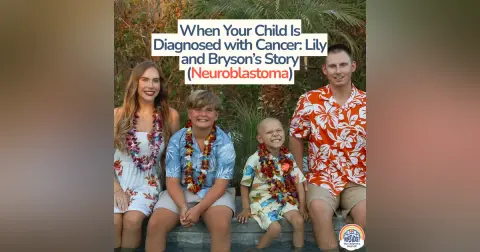
When Your Child Is Diagnosed with Cancer: Lily and Bryson's Story (Neuroblastoma)


Key Takeaways
- Lily and Bryson's story highlights the shocking reality parents face when medical professionals use terminology like neuroblastoma without clearly explaining that it is childhood cancer.
- Parents should feel fully empowered to ask doctors to slow down, define unfamiliar medical terms, and repeat information until it is fully understood.
- Child life specialists play an invaluable role by translating complex medical concepts into toddler-friendly terms and bringing a human, comforting presence into the hospital room.
- Lily and her husband turned their grief into action by founding Derail Childhood Cancer, a nonprofit that provides support backpacks and organizational binders for newly diagnosed families.
- Medical professionals in pediatric settings can significantly ease a family's trauma by taking the first 30 seconds of an interaction to play or connect directly with the child.
Lily, like many parents, was thrown into the medical parent role with little to no knowledge of anything involving her child, Bryson's, diagnosis of neuroblastoma. In this week's episode, Katie sits down with Lily to tell us her journey on learning how to feel empowered when speaking up for yourself and finding your community that will help you through difficult times.
Throughout Bryson's journey with cancer, Lily had felt in the dark and slightly intimidated when many medical phrases and small hiccups started to appear. Initially taking a step back, but then realizing she needed to step up and ask the professionals to break down everything in order for her to best represent her child.
Timestamps
2:15 - Introducing Lily
4:05 - Catching Bryson's Diagnosis
9:24 - Attempting to Understand Medical Terminology
12:55 - Medical Professionals Engaging with Children
16:44 - Creating a New Home in the Hospital
25:00 - Unique Family Bond
27:11 - Complications during Bryson's Journey
34:27 - Finding Support and Community
38:38 - Bryson's Impact
Resources
To listen to more episodes, head to insidethechildrenshospital.com
This podcast is for educational and informational purposes only and is not a substitute for medical advice, diagnosis, or treatment. Every child and family is different. Always talk with your child's healthcare team about questions or decisions related to their care.
The experiences and opinions shared by guests are their own and do not necessarily represent the views of their employers, healthcare organizations, or Inside the Children's Hospital.
Frequently Asked Questions
What is Lily and Bryson's story about?
Lily and Bryson's story shares the emotional journey of navigating a neuroblastoma diagnosis for a toddler, highlighting the communication barriers in hospitals and the founding of the Derail Childhood Cancer nonprofit.
What is Derail Childhood Cancer?
Derail Childhood Cancer is a nonprofit organization founded by Lily in honor of her son Bryson, known for his love of Thomas the Train, which provides support backpacks and organizational resources to newly diagnosed families.
How can parents advocate for themselves during a child's hospital stay?
Parents can advocate for their children by asking medical staff to break down complex terminology, slowing down conversations, and recording information or keeping it organized in a binder.
What role does a child life specialist play in pediatric hospitals?
Child life specialists help normalize the hospital environment by bringing toys, playing games, offering emotional support, and translating medical procedures into terms that both children and parents can understand.
0:00 Hello, my friends. I'm so happy you're here. I'm Katie Taylor, a certified childlife specialist, and you're listening to Inside the Children's Hospital. Today's a really special episode, and there's a part of Lily's story that she shared with me today that I think a lot of parents can relate to. And it's when the medical team is three steps ahead of where you are, like you're still existing in the moment that something has happened to your child. But they're already telling you or communicating something that you don't even know what it means yet. And in this instance, she talked about how the doctor was talking about neuroblastoma, but in her head, she hadn't even connected the dots yet that it was childhood cancer.
0:42 They only said neuroblastoma. They never used the word cancer at the beginning. And so for her, she was hearing these words, but it wasn't connecting. And I feel like this is a story that I hear over and over again. For parents in the medical setting. And it's even more of a reason for parents to feel empowered to ask doctors to slow down, to really define what words and terms mean. These terms are very natural and normal for medical staff, but they're not normal for somebody who doesn't work in the hospital, and they're not normal. When somebody isn't at their highest capacity. And I think we all know that parents in the hospital are not functioning at the highest capacity that they want to be. And that's not because they aren't completely able to, it's that they're in shock. They're fearful.
1:29 They're worried. They're taking care of another human. I cannot wait for you to meet Lily. Her amazing son Bryson was such a big fan of Thomas the Train. And they now share his legacy through their nonprofit called Derail Cancer. And um, it's an honor to be with Lily today. She's a mom whose worst fear has come true. Her son has cancer and her son died. But she's showing up now for those other parents to help them navigate what was so scary for her and to bring so much honor to Bryson's life. Let's get started. Lily, tell us about you, your Minnesota, Wisconsin life. Um, what makes you Lily?
2:15 Um, so I grew up, I was born and raised here. I grew up in St. Paul and Hastings. we um let's see. My husband and I got married in 2021, and uh we have lived here in our house right now for seven years. Um we have an older son named Paxton, he's 11. And We there's not a lot to do here in Minnesota. It's hot and humid right now. It's terrible. Lots of lakes, lots of beaches. Um, but yeah, my son plays baseball and he's about to start middle school this year. So that will be it's a whole new challenge.
2:57 That'll be a learning curve. Um I currently don't work. We actually just launched um our own nonprofit for childhood cancer. And so that's what I've been working on. my husband does construction, he's a carpenter. Wow, that's a huge learning curve. Um, what's the name of the foundation? Derail childhood cancer. And it's yes, Okay, derail childhood cancer. Let's do it. derail because Bryson was obsessed with trains, like obsessed. What was his favorite? Thomas. Yes. Everything Thomas. Course. Classic Thomas. Yes.
3:37 my gosh. And was your older son the same way? Was he into trains when he was little? No, not at all. Not at all. Cars and trucks and Hot Wheels and construction Yeah. Yeah. boy stuff, but no, not not the way Bryson loved trains. my gosh. Okay, well we have to hear about that for sure. Um, why don't you kind of start sharing a little bit about Bryson and what you guys went through and um what your experience was like at the very beginning. Yeah. He was born in 2020. He was a COVID baby. and he was two and a half when he was diagnosed in December of twenty twenty two, right before Christmas. Um he had come home from daycare with um like a I- I wouldn't call it a mask because at the time I didn't know that word, but it just looked like the side the left side of his abdomen looked swollen um in comparison to the right.
4:35 We thought he was constipated. He was a very, very chubby baby. And so he had a large belly. So it was kind of hard to tell Yeah. what was a new role and what wasn't. Yeah. And we decided to just watch it over the weekend. Um and by Monday it had gotten noticeably bigger. So we called his pediatrician. She recommended we come in. They did an x-ray and they said you need to go to children's. So my husband brought him there. I was at work. Um, I met him there though, and they did a CT which revealed a seven pound or seven-inch two-pound tumor that was about that big inside of his abdomen.
5:17 Um, it was on top of his left kidney and adrenal gland. And we didn't know that it was cancer. So we got there. You know, it was after hours, the hospital was closed, it was all night staff, and there was Nobody really around to kind of explain what was going on. And once he when he went back for CT, he had to be sedated. And when we were in the pre-op room, I saw on the whiteboard that we were being admitted afterwards. And all it said was the seventh floor. And so while he was in his CT, I was scouring the internet, trying to find a map of the hospital or a guide or something that listed all the floors so I could figure out.
6:00 what the heck was on this seventh floor. Like, where are we going? We get back to the pack you um to get him after he's waking up and they wheel us upstairs. And I'm thinking, okay, when we get off the elevator, it's gonna say, Welcome to the whatever unit. Yeah. No, it did not because we came up the back elevators. So Okay. we just got pushed right into a room and I walked in and on the table were pamphlets that said, Welcome to your cancer journey. And at the time, I was like, no, it's not cancer. They just put us on this floor because he has a mass, and this is where we wait to find out if it's the cancer or not.
6:47 Like it's just, we're just waiting right now. The doctor pulls up the CT and he says, it looks like Wilm's tumor. He still never said the word cancer. So in my mind, I thought, okay, so it is just a tumor. We'll get it out. We'll go home. Everything's fine. Um And then he sits down next to us and he says, So what comes to mind when you hear the word tumor or mass? And I said, Cancer. And he said, Well, cancer is an umbrella term. It can mean a lot of things. It doesn't always mean the worst of the worst. And but at that point, I like wasn't even listening. I just I I was off in La La Land somewhere pretending that that wasn't our life at the moment. And then the next few days, um were kind of a whirlwind. They did surgery and we met all kinds of people, social worker, case managers, childlife specialists, oncologists, surgeons, like everybody.
7:47 Um and there's not a lot I remember from those first few days. I just remember it was chaotic. It was very scary. It was very emotional. very dark and lonely. Thank you for sharing that part. Part of the story that I think is so important that you're mentioning is that Sometimes in healthcare, it's like everybody passes the bat thinks the baton is being passed to someone else, but it never actually makes it to the family. So it's like I'm sure the emergency room staff was like, we don't want to tell them it's cancer. They're never gonna see us again. We want it to come from someone they're gonna see.
8:27 And then you actually get in there, but it's like the word tumor can mean a lot of things, like you said. I do like his question, you know, what is this? What do you know about this so far? Because it actually talks to you directly and makes you have to come up with an answer and say, what do I know about this? But yeah, there can be so many missteps. And I don't know if you feel this way, but do you feel like sometimes you have to hear something four or five times and four or five different ways to finally grasp it? Absolutely. Absolutely. Yeah. From four or five different people. Right. Yeah. And that's like maybe on a good day.
9:09 So like Right, exactly. like that's on a good day when you're learning about something you've never heard before. Like A hundred percent. never mind the fact that you've just got the shock of a lifetime and it's your baby. Yeah. Yep. And I think that in the medical world they're so used to just using the proper terminology for everything. Cause to them it's just like another day at work when the parents don't know they don't know what neuroblastoma means. I had no idea that that meant cancer. They never told me he has cancer. And I understand that because Like he said, cancer is an umbrella term.
9:49 Um they're not going to just say, Hey, you have cancer. They're gonna give you your diagnosis. But I mean, he could have at least said this is a type of pediatric cancer. It's called robust. Yeah. Absolutely. Like you you have to lay it out there so succinctly and literally. Seriously. Like talk to me like I'm a two year old. Hold my hand and just be blunt. Right. Well and then like repeat back to me what I just said so I can make sure you know it. Yes, yes. Um, can you talk a little bit about the situation at the beginning where there the doctors are in the room kind of talking to you but what it felt like to you because they were using all these different terms?
10:34 It was very confusing. I remember like thinking, should I get my phone out and record this on an audio message? Should I get a notebook and a pen and paper? Like I need to I need to get all this information that they're saying because they're never gonna say it again and just stuff it all inside of a notebook or something because I knew it was important, but my brain did not have the capacity at the time to take it all in and understand. And they're throwing these new words at you and you have no idea what they mean and like I had no idea what an MIBG scan was or a port or just things like that. Um and I just everything they said, I just would ask a question, like, what is that? What does that mean?
11:18 What does that mean for him? Well, what do we do then? And it just felt like nobody ever explained it to us unless we asked. And when you're in that situation, you don't know what to ask. And Or you think of things to ask after the fact and you don't get a chance to have your question answered in the right moment at the right time. Yeah, so it was just very Very surreal, um trying to understand what that meant. Because you hear of people getting cancer all the time. Cancer is very common, but when it's somebody that means something to you, nonetheless, your child, it's like you're hearing it for the first time and you're like, wait, wait, wait, what is cancer?
12:10 Let me go all the way back to the beginning, because your mind cannot wrap around. that concept and no matter how many times somebody with a medical degree explains it to you, it's still like, this can't be possible that something has to be wrong. Like there's something is missing here. It it's so disheartening because this was not that long ago. No. This wasn't like 20 years ago when we didn't know better about like how to explain things to families. Like we know better. We Yeah. know what families need. And it Hundred percent. the ball just gets dropped, and families are the ones who suffer because of it.
12:53 Yeah. Can you talk about a time where like it did work? Like maybe a nurse or maybe it was child life or social work or a physician who like came in and was able to talk to you and you felt safe to ask questions. What was that like? So our child life specialist um was amazing. I would be best friends with her outside of the hospital. I'm sure she would too. Like she's she's so cool. Um, and she would always she could explain everything to me like I was a toddler. And she would just come in our room just to hang out with us because she liked chatting with us and I could talk to her like a normal person.
13:36 And it felt like I was talking to a normal person, except she had the answers to my question, unlike a normal person would, because she still has that medical background, but she also knows how to be human and empathize with somebody and try to create somewhat of a normal in a very not normal situation. Yeah, how did Bryson respond to people coming in and out the room? He hated it. He and he was not afraid to make that known. Yeah. He he used his voice. And Yeah.
14:17 he just didn't it at first I don't think he noticed, but then you know, once it became a pattern and there was constantly somebody poking him or looking at something or lifting his blankets up or t pulling his hands away from his iPad, any sort of disturbance, it made him mad and he didn't understand why. So I can see why that would make him mad. And so eventually, like he just the nurses would try to talk to him and he just wouldn't say anything. He would just stare at them. I think the most the people he interacted most with were the people that brought toys. So childlife, PT, OT, he knew those were the fun people that played with him and brought him fun stuff to do and You know, all the other people were the bad people that hurt him and scared him and all this stuff.
15:12 Yeah. you know, it's one of the things I try to tell as many like medical students or nurses as possible. I'm like, spend the ther first 30 seconds of every interaction playing. And if you don't have a toy, like just come up with a quick I spy game. Like just do something Yeah. that feels like you're acknowledging that the person you're taking care of is a child. Yes, yes. Make a balloon a hand balloon out of a of a glove Yeah. Yes, or something. the age old trick for sure. Like there's a reason Yeah, it's that doctors like when they the great doctors who listen pretend there's like a monkey inside or what are they listening to? Exactly. Exactly. Like it just works.
15:53 I say that all the time. Like if you nobody told you to be in pediatrics, you made that decision. So if you don't have what it takes to take care of children and understand that they're children and treat them like children, then why are you in that profession? Why don't you be an adult doctor if you're not here to play around? Like I I don't understand that. Lily, I need that tattooed on my back. That was Like it just doesn't make sense to me. No, you're exactly right. Why did you sign like why did you sign up for pediatrics? Yes, there were so many nurses and I get having a bad day, but being crabby for no reason all the time and just not having that nurturing just not having that character is so important when it comes to children.
16:45 Yeah. I w- I wanna talk about you for a little bit and like those first days that are a blur, like when you found yourself like coming out of the fog and maybe into like, okay, this is our reality, this is our routine now. Like I have to I do have to brush my teeth, I do need to shower. Talk about like coming out of that initial fog and any of the things that helped or looking back any of the things you wish you would have done differently. And when I'm thinking about this, I'm thinking about those like parents who are new in the hospital right now with a new diagnosis. Never. What do you want them to know? Um, so immediately after we kind of absorbed the information, I went into like full planning mode.
17:36 I was looking up everything on like what you can eat and what kills cancer naturally and how you can change your lifestyle and your diet and supplements and literally everything that you could look up. Best cleaning products for my house so that. my child wouldn't get sick. And I went down a huge rabbit hole on just trying to gather as much information as possible because I was like, we're going to tackle this. We're going to do it. They gave us a calendar of all of his chemo and we were like, I was like, we got this. We got this. It's laid out in front of me. I'm just going to do everything on the checklist and it'll be fine. Um but I part of what we're actually doing for our nonprofit is making backpacks that we hand out to new diagnoses because we know what it's like to end up admitted to the hospital unplanned without a phone charger or toiletries that are not the crappy hospital ones.
18:37 Yeah. And part of that includes a binder with business card holders and sleeves and a notepad so that they can take notes and put some put their paperwork that they're going to receive a lot of. somewhere where they can go back to it and it won't get lost, it won't get wrecked. Um, because I think that was the biggest thing was gathering all the information that you could, whether it meant writing down something you were going to look up later or writing down your question so you didn't forget it. Um or writing it down something that you found online that you're going to ask the doctor about, just anything like that.
19:20 I wish I hadn't been so worried about keeping my house clean because they get sick no matter what when they have no immune system. Yeah. But I spent days on my floor, like scrubbing the grout with a toothbrush. And my husband's probably like, You're doing that because our kid has cancer. Like, what what has led them to this? Yeah. No, that that might But I was just that makes sense in my head. Like I I get that. Yeah, I feel like as a mom, like you're just you just feel like you need to take these steps and if you do, it'll be fine. And Yeah. um so we both we both put our jobs because we were like, we're gonna we're gonna go all in. We are not leaving his side. We will travel as far as we have to, we will do whatever we have to to have the best outcome.
20:06 And so that's what we did. And I know a lot of people don't have that option, um, which makes it very even more difficult because um then you're not there all the time and you don't hear what the doctors are saying all the time and you miss out on that time with your child that you may never get back. it kind of led me to, you know, with neuroblastoma and your treatments, you kind of prepare for going into the hospital, getting ready for another treatment. What kinds of things did you find either ritually that worked, like keeping routine in the hospital, or what kinds of things did you bring to the hospital that made a lot of sense and maybe made things easier for you?
20:51 So I always tell everybody this. We kept a full size suitcase in our trunk at all times, fully stocked with full size bathroom products, extra clothes, like everything we would need for an admission that was unplanned so that we would not have to pack a bag in the moment. All times it was in our car. That was great. Um and it also had extra phone chargers, like literally we wouldn't have to think of anything. It had everything. It kind of sucked buying two of everything. So smart. But in hindsight, it saved us so much. Um, he brought all of his toys.
21:31 Well, not all of his toys. He brought trains. He would Training. bring like um those 13 by 13 cube baskets. Yeah. He would bring three of those filled with trains to the hospital. And tell me what what did that do for him? Um, that was his happy place. Um, it you know, actually a lot. So fine motor skills. PT- OT loved that that he played Yeah. with his trains. Same with PT, because he would squat down on the floor and just play, play, play all day. But it was his joy and his escape from everything that was going on. Um, when he was playing with his trains, he didn't he didn't think about that we were at the hospital.
22:15 He was just happy that he was able to bring his toys there and that he could still do what he wanted to do any even though we were making him stay at this horrible place and feel horrible. And um we also would bring a like one of those mesh fold up laundry baskets because you get lots of dirty clothes. There's lots of bodily fluids, um unexpected, you know blowouts or what have you. Right. Yeah. And that was very helpful. Um our home hospital had a uh washer and dryer on the oncology floor, which was fabulous.
22:56 but we learned that that is not on every oncology floor at other hospitals. So um but most of the time we could just bring it to Ronald McDonald and wash it there. Even if we weren't staying, they would still let us use that. But the laundry basket was a huge help. And Let's see what else. Obviously, Like even for your clothes, like 'cause your stuff has to go somewhere too. very Yeah. Yeah, exactly. Yep. Yeah. Everything soiled, any, yeah. And it just, it's a cheap little laundry basket if it ever got ripped, we just replace it. Yeah. Fold it up, fit in our suitcase. Um and we brought our we always brought our own pillows and blankets.
23:37 Uh I think everybody knows how uncomfortable the hospital. Pillows and blankets are. And it just made everything feel cozy. So we would you know, put sheets on his bed and bring all of his favorite blankets and his pillow and stuffed animals. And we would bring our stuff for our bed. And even just doing that when we got to the hospital made it feel 10 times cosier. When we knew we were getting admitted, we would we had a routine. We would get in our room, we would you know, start unloading everything, put our toiletries in the bathroom, put our clothes in. They usually had like some drawers or a cabinet or something.
24:20 And they also had mini fridges in the patient room. So we would stock up and put some groceries in there. And once we were all unloaded, my husband would take everything back down to the car, like the wagon and the suitcase. And then we were just like settled into our own little studio apartment. Yeah, for sure. Yeah. And you had your other son to think about at home too. Yeah. Yeah. And there's so much just like your heart being split in two places and you're always having to choose and it's just it's not fair and it doesn't w work well for anybody ever.
25:01 Yeah. No, our son was, I think, let me think, he was eight at the time. And when he was when Bryson was diagnosed, we actually decided that Paxton was gonna go live with my in-laws in San Diego for the time being because we didn't know how we were gonna make it work, getting him to and from school when we were having to drive to Minneapolis every day. And We didn't want him bringing any germs home from school that would make Bryson sick. Um, we knew that Paxton needed to be surrounded by love and attention. And we knew that he would not get that here from us because our attention had to be somewhere else. And we knew that wouldn't be fair to him.
25:46 So as hard as it was, he went to go live with my in-laws in San Diego and he ended up loving it. I mean, he had a blast. He made new friends at the school that he went to and my husband's siblings are all younger than him. They're all teenagers. And so he got to hang out with all the teenagers and they knew to kind of make him feel special and uplift him and include him in things and do fun stuff with him. So it was hard to watch from afar and have to see it all, you know, on my phone instead of in person. But I wouldn't have had it any other way because he would have been miserable if he were having to travel with us back and forth to the hospital.
26:29 or, you know, have us not be there, whether it's physically or emotionally. He just Yeah. he deserved to have his own space. I love that. And it sounds like I I can imagine that whether it was your parents or your husband's parents were just they want you wanna do something to be helpful for the people you love when they're hurting. And when you've let people help you, it makes them feel good. Like you're doing Yes. something. So it's like the big teenage cousins, I'm sure, were are never gonna forget that time with him. And No. they have those special relationships. And I think that's really special. Yeah. Yeah. And they talk about it a lot.
27:11 you know, when you wrote to me and we talked about some of the complications that came with the treatment and how did you how did you cope with those? And yeah, because it's not always just that kind of checklist or that calendar they show you at the beginning and things will pop up and how did you get through that? Each one was ah obviously very scary. And each one, each setback we had, we wondered if we were gonna lose him. There was usually a very good chance that we were. And I just you become very like hyper vigilant and fight or flight mode.
27:56 Like you you start to you feel like you've been slacking and you need to get back on top and back into that planning mode. And when like the first so like one of the first setbacks, I guess you would say, is instead of biopsying his tumor, they removed it right away. So he was unable to start chemo right away because he had to heal from surgery. And that is not typical neuroblastoma treatment. or protocol normally they biopsy it figure out what it is treat it to get it as small as possible and then remove it but they did not do that they went in and removed it right away and it ruptured and so then there was neuroblastoma cells all throughout his body at that point and at the time I didn't know that that was not normal. I no Yeah, how would you how would you even know to ask or think?
28:57 I just thought, sweet, they're getting the tumor out. Like in my Same. mind, surgery was always the best option. You're you're debulking, you're physically removing the bad stuff. and then another one was he uh was having another tumor resection and they nicked a lymphatic valve that resulted in a chyle leak, and he was in the hospital for over a month with a chest tube. had to be on a low-fat diet. And every setback put off chemo. Like he couldn't get chemo if he had anything else going on because of the risk, all the risks. And I just remember it was always the same surgeon.
29:43 And I just remember once I started noticing, I don't want to say a pattern because it's not like I don't want to talk bad about him. He's not Yeah. a bad surgeon. But every time I noticed something, I would Just kind of make note of it. I would try to record our conversations when he would come in the room. Um, and I also noticed that he got very quiet when all of that started happening. And that really upset me. uh because it's almost like they knew and they didn't want to say. And so at one point, I actually did reach out to a lawyer and just ask them a few questions.
30:23 And they told me basically they can't really do anything unless it impacts the outcome. And so every time there was a setback and we thought we were gonna lose him, we were like, God, we gotta contact the lawyer now. Well In hindsight, we did lose him and there were so many setbacks that part of me is like, what if it was because of that? Like all along, he would um I think in between every frontline cycle of chemo, he got a neutropenic fever and we were admitted in between cycles every time. He had sepsis twice.
31:03 Um he basically whatever could go wrong did go wrong with him. He Like had the most bizarre list of allergies. He you know, had very bizarre things that came up and it just kind of put a halt on his treatment. And I always wonder if that Had anything to do with the way his disease progressed and how it would have been different. and another thing they told us in the beginning when they told us that he had cancer was that we should not go anywhere else for a second opinion, and we shouldn't read anything on the internet about it because it would scare us. And so I didn't. I trusted them and I listened to them.
31:53 And it wasn't until It was too late that I found out that I needed to be more, do more. And at that point he had relapsed a couple of times. And so we were still trying, but I just I just remember thinking I wish I would not have listened to him. Like we we're trained to trust doctors because they are the experts. And the fact that I felt like I could trust him, but I was blindsided the whole time will never not eat away at me. Like I tell people this all the time, doctors know medicine, but you know your kid. And there's no way they know your kid better than you do.
32:37 And so yeah, I remember I reached out to MSK in New York City. And they're one of I think they might be the top neuroblastoma hospital in the country. And our doctor was like, Well, we can do their approach from here. We can do what MSK does in Minnesota so that you don't have to travel. And we thought that was great. We were like, sweet, best of both worlds. Um Come to find out that was not exactly what happened. Um, there was a few things that his doctor decided that he was gonna do, not without telling us, because in a roundabout way he did.
33:21 But it was always in those papers that have a million words on them, and you just sign it because you gotta sign it and everything's moving fast, and they're like, we gotta get this done. But Yeah, I just I started losing trust. There was throughout his whole journey, there was a lot of trust that was lost for The healthcare system in general, I would say. Yeah, it's it makes me think of this term that I learned in therapy with my husband, which is like like there's so many ruptures that happen and then you have to repair. And if they're not repaired, like specifically repaired, that rupture is gonna grow.
34:06 Mm-hmm. And so it makes so much sense that when you have all these ruptures and you don't feel like they're being taken care of that Yes. that that trust is really, really hard to get back. And I can imagine Yeah. even for like now for you in healthcare and for your other son in healthcare. Absolutely. And for your and so I always like when I'm thinking about families that we support and anyone meeting anyone in a hospital, I'm like, there's so much up to their story. There's so much of their story that happened up and you're just seeing them right now, this tiny little Yeah. blip. Like we have no Yeah. idea what you've been through. And even somebody who's so engaged in your care can't possibly know everything, but you do. You do. So what's the message that you send or that you tell other neuroblastoma families?
35:00 immediately get a second opinion, get a third opinion, get a tenth opinion. Like there, there are a lot of very, very good neuroblastoma doctors in this country. Um and I highly recommend finding them and going to them. Home hospitals are great. They just don't see it as much. They don't study it as much. They don't have the resources that the big hospitals do. I loved our home hospital, but I so wish in the beginning we would have sought better care. That's always the first thing I tell people is get a second opinion.
35:42 Do not put all of your trust into one doctor. Um, and I always recommend. joining like the Facebook groups of parents where they can ask questions and stuff like that. I was it was recommended that I did that in the beginning, but I did not because I was scared. I did not want to see things that I couldn't unsee or read things that I couldn't unread. And Right. eventually I did end up joining those groups and I just wished I had done it all along because There's so much information in those groups.
36:22 And I I truly believe that the most valuable source of knowledge is from the parents that have walked this path. A doctor can tell you what's typical and what's not typical. A parent can tell you the truth. Lily, this is it. This is like the whole point Yeah. of this podcast. And the whole point that I am so grateful to you for like having to go back and relive some really hard moments and being willing to share them today. Because you're right. Like, you know, I feel like the response, and I think it's getting a little bit better, but like when whoever says don't Google this.
37:06 Mm-hmm. The next breath needs to be, but join the Facebook group for parents. Yeah. Like we just can't end it at don't Google, but these Facebook groups are it. And there's a Yes. lot of protective mama bears in those too. And if there's like naysayers or people sharing inaccurate information, that's a risk whenever you're online, right? Like, don't do this protocol, do this one, and like you have to be able to sift through that. But Yes. The connection and the relationships that you get with other families just they they can't be matched. Not at all. I Some of my best friends in life are the ones that I made on this journey and their fellow parents. And I came out of this with more friends than I had going into it, which was the last thing I expected when my child got diagnosed with cancer.
38:03 Yeah. But these moms that I have met on the internet never met in real life. I have so much love and appreciation for them and their kids. And I wouldn't have learned that in seen that perspective had this not happened. And that is something that I really value and appreciate is having those connections and just being able to speak the same language and not have to translate and explain because they just Tell me your favorite part about being a mom to your two boys.
38:45 Oh boy, gosh. Um I love When people acknowledge the hard work that we put into raising our kids. I, you know, strive to make them be kind and respectful and compassionate. And when people come to me and say, my gosh, your your son did this today and I just um it warmed my heart. I'm like, okay, I know I'm doing something right.
39:25 Like I'm not failing here at least. But um yeah, it makes me feel good knowing that others can see. And I think this whole journey has really made Paxton more compassionate towards other people and being able to sympathize with people who have had relatives die because this was like the first relative that of his that he remembers dying. Um and it was a big one. And We openly talk about cancer still and other cancer families and you know, I tell him their stories and he just he just kind of stops and you know, you can tell that it's registering in his head and he's actually feeling those emotions for that person and not just being like, That's sad. Like Yeah.
40:22 it really has opened his mind and his heart and I love that because I don't want him to be bitter and cold the rest of his life because his brother died. I love that it kind of turned him around to see the good in people and the good in the world and the value in family and relationships and love. And yeah. And that's how I want people to see my children is that they are loved and they are respectful and they are kind. Mm-hmm. And like sweet Bryson just so full of love, I can tell because of his brother Yeah.
41:02 and like the way you're talking about him. I wanna hear, uh first of all, I love derail cancer. I love that it's got this nod to his trains. And part of what you do are backpacks for families, but what's another way we can support your organization? So we also fund childhood cancer research. Um and another part of what we do is I am learning how to become a death doula. I um We had a terrible hospice experience.
41:44 And I after he died, I learned that I learned what a death doula is and wished I had had somebody like that with me when he was dying because it's terrifying and it's all new and scary. And again, they don't explain it how they should. And um So I think that is very important to have an emotional support person there that knows what's happening, but isn't there to like for medicine, there for the family to answer questions, to sit with them, to, you know, interpret things and stuff like that.
42:29 And so we want to, you know, provide bereavement and emotional support for families going through that. Um and let's see where programs obviously raising awareness and um doing like blood drives and I have a whole list All of the things. All of the things. of all of her programs and I can think of them right now. But yes. Yeah. Yeah. Well so where do people where can people find is it derailcancer dot org? It's derailcc.org. Okay, draailc dot org and Yes.
43:10 you can go and learn about all the amazing things that exist because man Bryson has some really cool parents who are Thank you. changing the world because of him. Yes, I well I have just it's been an honor to to get to know you. Were there any questions or any stories that you hoped to tell that I didn't ask you about and you were hoping to share? Not that I can think of. Um, I know. if anybody has questions though for me, they can always message me in my inbox. I tell everybody I'm an open book. No questions are off limits. I am impossible to offend.
43:52 I'm just here to help. Like I want to be the person that I wish I had all along. I want to help people understand and I want to answer questions and I want to emotionally support them and I want to be somebody that they can just talk to. And so yeah, I am always open for questions or comments or anything because I don't think anybody my gosh. should be alone in this journey. You are a gift. Thank you. Mm. Before you go, if this story taught you something, made you feel less alone, or helped you better understand what families experience in pediatric healthcare, would you help us by passing it forward?
44:39 Podcasts like this grow because people share them. Send an episode to a friend, a neighbor, another parent, or share it with a Facebook group or community where you think someone might need to hear it. And if you haven't already, follow the show and leave us a review. it helps more families find these stories and learn from the parents who have walked this path before. Thank you so much for listening to Inside the Children's Hospital. We'll see you next time.

